BUYER'S GUIDE - 12 MIN READ
How Do Material, Coating, Design and Rating Differences Affect Safety Glove Selection?
Editorial information, sources and corrections
Compare safety glove liners, coatings, coverage and protection ratings with a practical selection matrix for industrial buyers and controlled sample trials.
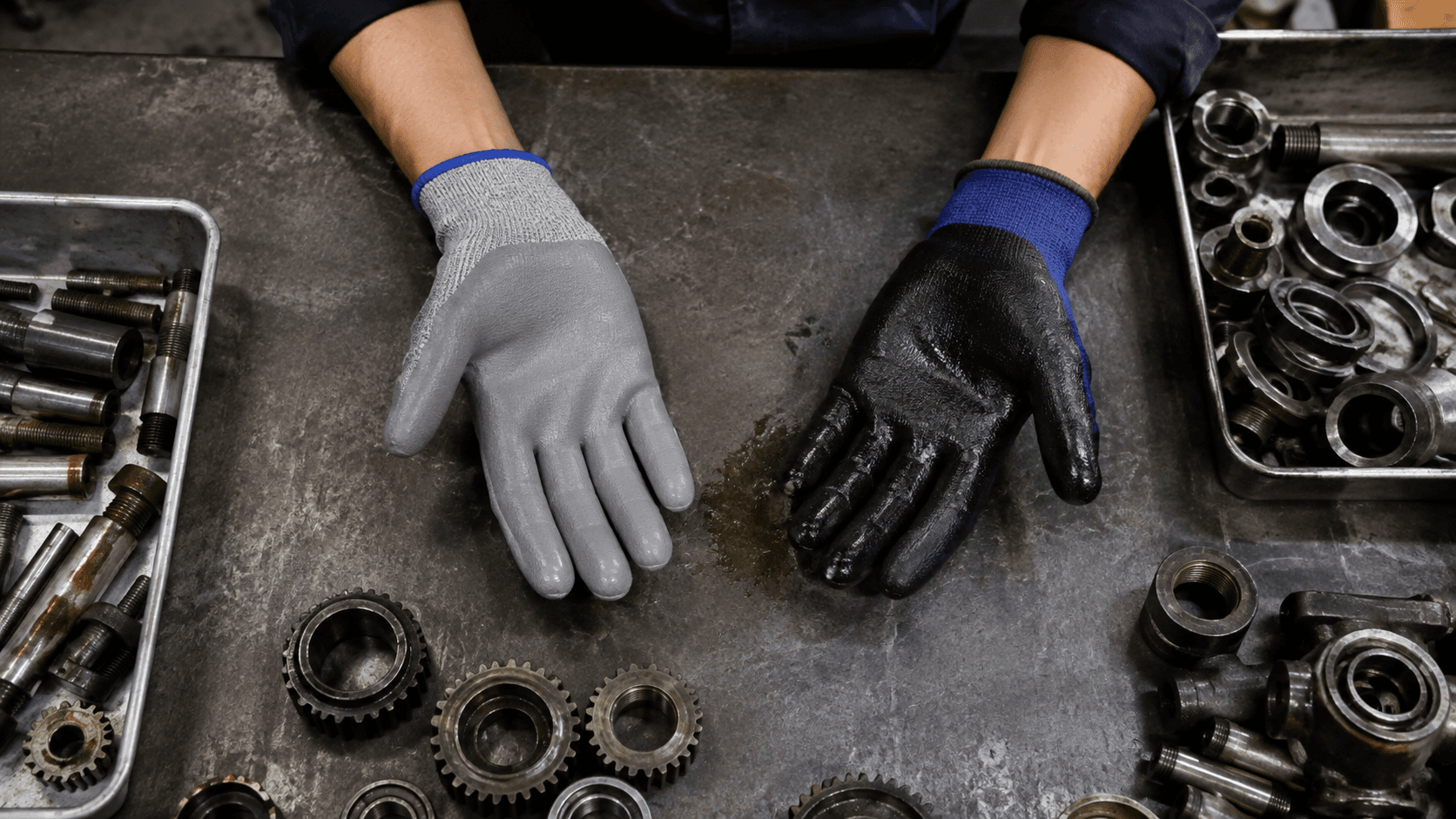
Illustrative image, not evidence of testing or a documented customer project. Procurement guidance does not replace product instructions or competent workplace assessment.
Primary topic: safety gloves material coating design comparison
Introduction
Safety glove selection should compare complete products, not material names in isolation. The liner influences fit and handling feel; the coating influences the contact surface; the pattern and coverage influence how the glove behaves on the hand; and verified ratings describe particular tested properties. None of these elements alone proves that a glove is suitable for a workplace task.
For an importer comparing apparently similar products, the practical question is not whether nitrile is better than polyurethane in general. It is whether a particular model provides the required protection and usable handling performance in the intended conditions, with evidence and supply consistency to support the purchase. This guide shows how to make that comparison without assuming that thicker, heavier, more expensive or more highly rated always means better for every application.
Define the comparison before discussing materials
Write a short task description that includes the objects handled, relevant hazards, contamination, contact conditions, handling movements and other equipment worn. Separate sharp dry components from oily maintenance parts, and separate both from chemical transfer. These may occur in the same factory but require different selection evidence. An industry label is a useful starting point, not a complete specification.
List the requirements that cannot be traded away, such as an identified protective property, suitable chemical data or a necessary cuff interface. Then list preferences such as color, packaging and a particular handling feel. This prevents an attractive sample from winning because it feels comfortable while an essential protection question remains unanswered.
The US OSHA hand protection standard ties selection to the task, conditions, duration and identified hazards. For buyers outside the United States, it is a useful decision principle, not a substitute for local obligations. Our hazard-based safety glove selection guide explains the earlier assessment step.
Understand what the liner contributes
Fiber names are not finished-glove ratings
A knitted liner may combine several fibers to achieve a particular structure, feel and protective performance. Two gloves described with the same headline fiber can differ in yarn construction, blend, thickness, fit and reinforcement. Ask for the exact model's data rather than inferring performance from a photograph or an abbreviated catalog description.
Likewise, a familiar high-performance fiber name does not establish protection against every hazard. Cut resistance, heat behavior, chemical suitability and electrical protection are separate questions. Procurement should avoid replacing a multi-part specification with a single material preference unless a technical reviewer has explained why that material is necessary for the application.
Gauge is a construction descriptor
Knit gauge can help describe how a liner is made, but it is not a universal protection scale. A fine-looking glove may be useful for delicate handling, yet its suitability still depends on the finished construction and required ratings. Compare gauge alongside measured dimensions, coating, protective evidence and wearer feedback, not as a ranking from basic to premium.
Ask suppliers to explain any proposed liner change between the sample and bulk production. A substitution intended to preserve appearance may alter stretch, fit or feel. The purchase agreement should require review of relevant changes even where the new material is presented as equivalent or improved.
Compare coatings as contact surfaces
Nitrile, polyurethane and latex are families
Nitrile, polyurethane and natural rubber latex describe broad coating families, not identical finished products. Texture, formulation, thickness, coverage and the underlying liner all matter. A smooth coating, a textured surface and a foam construction can behave differently even when the catalog uses the same polymer name.
Manufacturer resources such as Ansell's coating comparison guide illustrate the range of coating approaches. Use such guides to form questions for a supplier, not to transfer a claim from one manufacturer's product to another. The purchasing decision must remain tied to the proposed model.
Grip must be evaluated in the intended condition
A glove that handles dry cardboard well may not provide the same control with a wet or oily object. Define what grip means for the task: holding a large package, positioning a small fastener or maintaining control of a permitted hand tool are different activities. A general statement of excellent grip is difficult to verify without this context.
Use safe, controlled handling exercises with nonhazardous representative objects. Record loss of control, excessive gripping effort, difficulty releasing an object and changes after realistic permitted use. Do not create a hazardous exposure simply to compare samples. Where a performance claim depends on a formal test, obtain the relevant evidence in addition to operational feedback.
Coverage changes the product's practical behavior
Palm coating, fingertip coverage, three-quarter dipping and full coating are not merely styling options. They change the exposed textile area and the surfaces available for contact. A buyer should map the contact location: a palm-focused handling task differs from one in which the back of the hand or wrist may encounter a substance.
Do not call a fully coated mechanical glove chemical protective without the appropriate model-specific evidence. A continuous-looking surface is not proof of resistance to the actual chemical or mixture. Similarly, an uncoated back should not be overlooked when the task exposes the whole hand rather than only the gripping surface.
Cuff design deserves a separate comparison. A knit wrist, open cuff or extended gauntlet affects donning, fit and the interface with clothing. Longer is not automatically safer if the design conflicts with another item or the task. Review coverage together with the full clothing arrangement and the conditions of work.
Read ratings as separate pieces of evidence
A glove can perform strongly in one tested property and differently in another. Record the standard, edition, test method, result and exact model together. A bare number without its method is not a useful specification. Do not convert between different classification systems by assuming their letters or numbers are interchangeable.
Look for missing information as carefully as high results. If the application requires a particular protective property and the supplier provides only unrelated test data, the comparison is incomplete. An untested or unreported property should not be treated as a zero or as an implied pass; ask what the notation means in the relevant document.
The safety glove specifications and protection ratings guide provides a separate reading framework. Keep that technical review distinct from a comfort trial: workers can report fit and handling, but their preference cannot establish a laboratory protection rating.
Build a decision matrix with meaningful questions
| Product element | Comparison question | Evidence or evaluation |
|---|---|---|
| Liner construction | Does it fit the relevant hands and support the task? | Model data, dimensions and controlled fitting |
| Coating and texture | Does the contact surface provide usable handling control? | Relevant claim evidence and safe task simulation |
| Coverage | Are the required contact areas addressed? | Product drawing, sample and hazard review |
| Protective ratings | Are the required properties demonstrated? | Model-linked reports and applicable documentation |
| Cuff and pattern | Does the glove work with sleeves and equipment? | Complete-ensemble compatibility review |
| Care requirements | Can the site maintain the approved condition? | Current manufacturer instructions and issue process |
Use a pass-or-resolve column for mandatory requirements before applying any preference score. A weighted score can otherwise hide a failed safety condition behind several attractive convenience features. Only compare price after the technically acceptable group is identified.
Send Your Requirements with your objects handled, contact conditions, required ratings and current glove model. PPEgen can discuss candidate constructions and the documents needed for a like-for-like comparison.
Three hypothetical comparisons that need different answers
Dry precision assembly
Imagine an assembly station placing small, nonhazardous components during a controlled trial. The first comparison might focus on fingertip bulk, finger length, grip release and the ability to manipulate approved tools. A thick coating may feel durable but interfere with positioning. A thin construction may feel precise but still needs to meet every identified protection requirement before use.
Record the sizes each participant tried and the specific movements that caused difficulty. If a glove is too large, its poor score does not prove the whole model is unsuitable. Offer the correct size before comparing constructions. Avoid claiming improved productivity from a short demonstration; report only what the trial actually observed.
Oily component handling
For a separate task involving oily components, first establish what substance is present and whether chemical protection is required. The material comparison cannot stop at grip. The evaluation should distinguish contact with the oil, the condition of the object and any mechanical hazards from edges or surfaces.
Among technically suitable candidates, evaluate permitted handling with a controlled, safe setup. Observe whether the user changes grip technique or applies excessive force. A model that performs well dry but poorly in the relevant condition should not be accepted based on its dry trial. Document the condition so repeat orders are evaluated consistently.
Wet cleaning work
In a cleaning application, the cleaning product and contact conditions can determine the evidence required. A glove selected for dry abrasion may be irrelevant, regardless of coating color or apparent thickness. The material decision needs the exact substance information and manufacturer advice for the proposed glove, followed by fit and task review.
These examples are hypothetical selection exercises, not PPEgen test results or customer case studies. They show why a single best coating table cannot replace an application-specific decision. The right shortlist may contain different constructions for each task rather than one compromise product for the whole facility.
Avoid treating one feature as a universal upgrade
Added padding, back-of-hand structures, touchscreen features and extended cuffs may solve particular operational problems. Each also needs review for fit, movement, maintenance and compatibility. Do not assume an additional feature is cost-free in practical terms. Ask what problem it addresses and how the buyer will confirm that benefit.
Color is useful for identification only when the site defines the code and trains staff. It does not establish a performance level. A black glove from one supplier should not replace a black glove from another because the color looks familiar. Put the model code and approved application on the stock record.
Likewise, branding and packaging can help issue control without changing the protective function. Keep those requests separate from the technical specification. This makes it easier to see whether a price difference comes from a functional construction change, a commercial service or simply a presentation preference.
Freeze the approved construction for repeat orders
After sample approval, retain the model data, approved specification revision, relevant evidence, size schedule and representative sample. Define which changes require notification: liner, coating formulation, coverage, pattern, manufacturing location, marking or packaging. Not every change has the same significance, but none should be hidden behind an unchanged purchasing nickname.
Ask the supplier how bulk production is linked to the approved sample. Factory testing and shipment inspection answer different questions: one may assess a defined performance property, while the other checks the supplied lot against agreed requirements. Neither should be described vaguely as quality approved without explaining scope and traceability.
For subsequent comparisons, change one decision variable at a time where practical. If the buyer changes size, coating and task simultaneously, the result is difficult to interpret. A simple comparison log makes future sourcing decisions more defensible and prevents repeated trials of products already rejected for a documented reason.
Make the comparison reproducible across sites
When several facilities buy the same glove, document which conditions are genuinely shared. A model approved for one assembly bench should not automatically become the corporate default for cleaning or maintenance. Create a short application code that connects the glove to the approved task, required evidence and size options. Keep the purchasing code separate from a broad description such as general purpose.
During a controlled comparison, give participants the same instructions and suitable sizes. Record observations before discussing preferences as a group so one person's enthusiasm does not erase another person's difficulty. Useful notes describe the movement, object and problem: for example, difficulty picking up a blunt sample component because the fingertip is too long. A simple comfortable or uncomfortable score is less useful without that explanation.
If the comparison produces conflicting feedback, investigate whether hand shape, size selection or task variation explains it. The result may justify two approved models rather than forcing a single winner. Procurement can still control complexity by specifying exactly which users or tasks each option serves. This approach preserves meaningful choice while avoiding an uncontrolled catalog of substitutes. It also gives future buyers a defensible reason for maintaining more than one construction, instead of treating every additional model as unnecessary duplication.
FAQ
Is a nitrile-coated glove always suitable for chemicals?
No. A mechanical glove with a nitrile coating is not automatically a chemical protective glove. Check the exact model, coverage, intended use and relevant evidence for the actual substance and conditions. Do not rely on the polymer name alone.
Does a higher knit gauge mean higher cut protection?
No universal relationship should be assumed. Gauge describes a construction characteristic, while protection depends on the complete glove and the applicable test result. Compare the model's documented performance and fit rather than ranking gauge numbers as protection levels.
Should buyers always choose the highest available rating?
Choose ratings that address the assessed hazards, then evaluate fit, compatibility and usability among suitable products. The highest result in one property does not establish suitability for every hazard or guarantee that the glove supports the required work movements.
Can two gloves with the same rating be interchangeable?
Not automatically. They may differ in sizing, coverage, grip, cleaning instructions, other protective properties and documentation. Review the complete specification and conduct an appropriate change assessment before treating them as substitutes in a purchasing system.
What should be sent with a sample comparison request?
Provide the task, hazards, contact conditions, required evidence, size range and current problems. Include photographs of objects or interfaces when safe and appropriate, but do not send sensitive workplace details unnecessarily. Ask for model-specific data and explain which requirements are mandatory.
Conclusion
Material, coating, design and rating differences matter because they affect different parts of the selection decision. Compare the finished glove against a defined task, verify mandatory protection evidence and evaluate fit and handling safely. The strongest purchasing specification records why a model is suitable and what must remain unchanged in future deliveries.
Get a Quote or contact info@ppegen.com with your technical requirements and target quantities. PPEgen can help structure a sourcing comparison without treating a material name or catalog rating as a universal safety guarantee.
BUYER RESOURCES
Continue your PPE sourcing research.
Explore relevant PPE categories and a primary safety reference alongside this guide.Use this source alongside destination-market requirements for the exact product and application.
READY TO DISCUSS YOUR REQUIREMENT?