BUYER'S GUIDE - 10 MIN READ
Mobile Workplace First-Aid Kits: Sizing and Restocking for Field Crews
Editorial information, sources and corrections
Plan first-aid kits for field crews and vehicles by risk, team size, remoteness and replenishment needs, with an RFQ and inspection checklist.

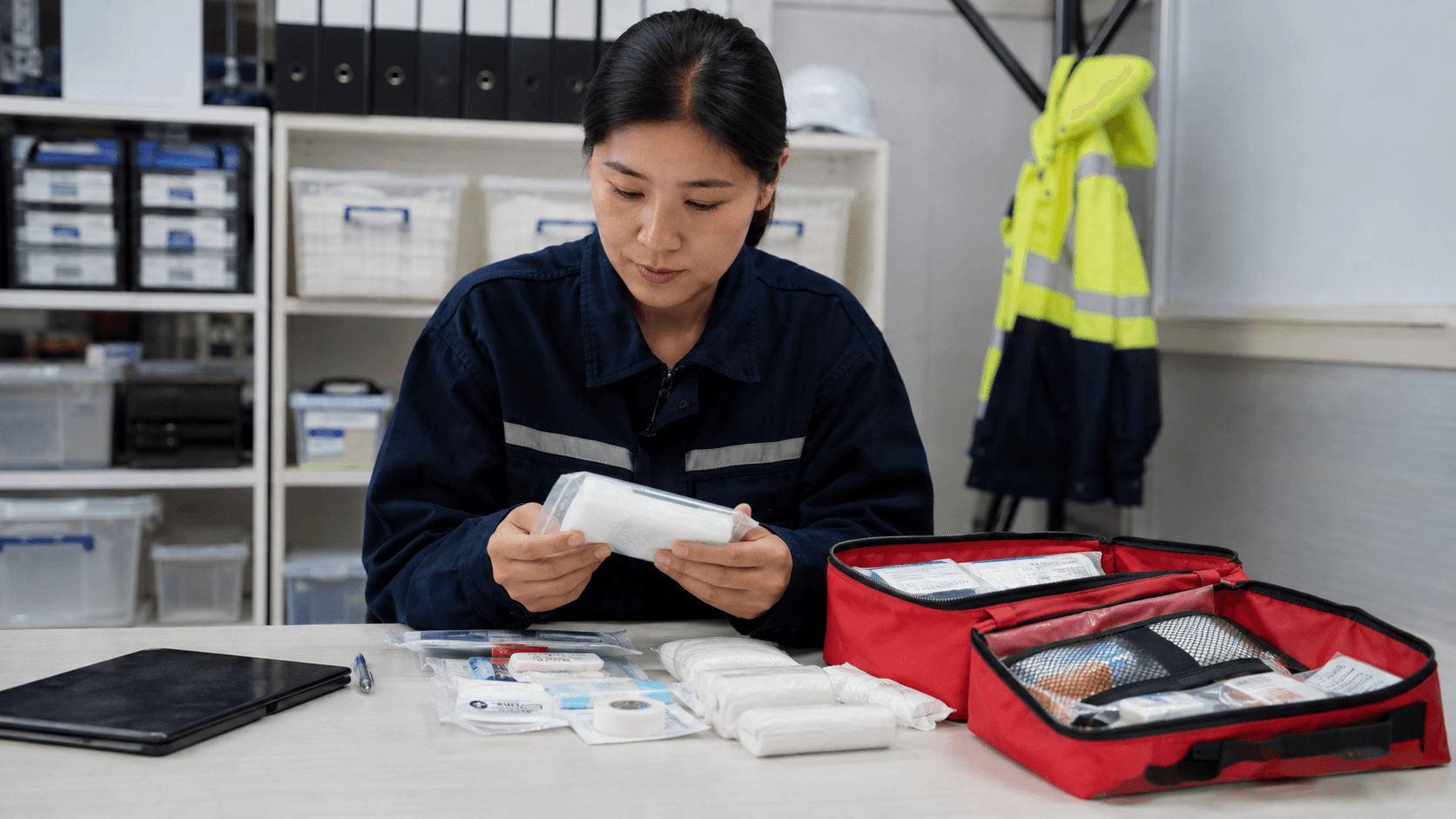
Illustrative image, not evidence of testing or a documented customer project. Procurement guidance does not replace product instructions or competent workplace assessment.
Primary topic: mobile workplace first aid kit procurement
Introduction
A first-aid kit for a moving crew is not simply a smaller wall-mounted box. The team may work at different sites, face changing hazards, spend time away from immediate help and use a vehicle subject to heat, moisture and rough handling. Kit contents, trained people, access and restocking must be planned together. A supplier's generic "50-person kit" label cannot replace an employer's first-aid needs assessment.
This guide helps procurement teams structure that assessment and control field stock. It is not medical advice and does not prescribe emergency treatment. Destination rules and the employer's competent first-aid personnel determine the provision required.
Quick answer: Size mobile first-aid provision from team size, task hazards, travel/remoteness, access to emergency services and the level of trained first aiders—not from a product's advertised headcount alone. Choose a protected, accessible kit, assign a custodian, inspect contents and expiry information regularly, and replenish immediately after use.
Begin with a needs assessment
The HSE employer first-aid guidance calls for a needs assessment based on work and workforce. Its first-aid FAQ clarifies practical employer considerations. For US operations, review OSHA's medical and first-aid guidance and applicable local requirements. Importers should not assume one country's kit contents fulfill another's rules.
Describe the crew's work: vehicle maintenance, construction inspection, utility repair, delivery or outdoor installation. Note likely hazards, number of workers, lone work, shift duration, distance to emergency services, communication coverage and whether the crew visits several customer sites. The assessment may identify training, rescue or communication needs beyond the kit itself.
Separate kit count from kit contents
One large kit locked in a vehicle across the site may be less useful than appropriately located smaller kits. Conversely, duplicating low-use supplies in every bag can create expiry waste. Have the responsible person decide number and location. Map who can access each kit during actual work, not only when the vehicle is parked at the depot.
Write a contents specification
Do not copy a marketing list without checking task and jurisdiction. Specify the required categories and quantities established by the site's first-aid lead, plus case design, instructions, replacement pack format, relevant labeling and any necessary language. If a customer asks for specialized items, confirm training, legal permissions, storage conditions and whether they belong in a general field kit.
| Procurement field | Reason to specify |
|---|---|
| Kit identity and location | Crew can find the right kit quickly |
| Approved contents list | Receiving and restock control |
| Packaging and seals | Protects contents in transit |
| Expiry/lot tracking | Supports rotation and product notices |
| Replacement packs | Reduces ad hoc substitutions |
| Instructions and contacts | Makes access and escalation clear |
A first-aid kit is not a substitute for trained responders or emergency services. The responsible team should decide whether site-specific hazards require additional emergency arrangements.
Test access and durability
Trial the kit in its intended vehicle or field bag. Can a worker open it with clean hands and identify contents quickly? Does it remain secured during travel yet accessible when needed? Are labels readable in poor light? Is there a protected compartment to reduce moisture or dirt? Test the case and layout in a safe, non-emergency simulation; do not stage medical treatment to prove a kit's performance.
Field storage can be harsh. Check the supplier's temperature and moisture limits for any contents and ensure the vehicle environment does not exceed them. Items that cannot be stored in a hot parked vehicle may need a different location or handling policy. Assign a named custodian for inspection; a kit with no owner will eventually have missing or expired contents.
Mid-article CTA — Send Your Requirements: Tell PPEgen the crew size, work type, countries of use, vehicles and approved contents list. We can prepare a kit-and-refill quotation aligned with your first-aid lead's requirements. Contact us.
Set restock and inspection triggers
Inspect on a documented schedule and after each use, vehicle reassignment, damaged seal or incident. Count against the approved contents list, check packaging, condition and expiry information, and replace used or questionable items. A sealed kit may still need date review. Use first-expiring-first-out rotation where appropriate and permitted by product instructions.
At the depot, maintain a small reserve of approved refill packs. Keep the reserve traceable by lot and do not replace an unavailable item with a look-alike without first-aid lead approval. Record the reason for consumption and recurring shortages; a frequently used item may warrant a change in stock or work controls.
An illustrative scenario: a crew of several technicians rotates between remote sites and returns to the depot only twice a week. Procurement puts one kit in the vehicle and one with the team, assigns a custodian and establishes a post-use check. The exact contents and kit count would still need the employer's assessment. This is a hypothetical workflow, not a claim about a PPEgen delivery.
The general first-aid kit procurement checklist covers stationary facilities. The first-aid products category provides a catalog starting point, subject to destination rules.
Check shipments before issue
Compare delivered cases and refill packs with the approved contents list, quantities, packaging, instructions, lot and expiration information. Inspect representative kits from multiple cartons. Quarantine broken seals, missing items or damaged packaging. A prepacked kit photo is not sufficient evidence for every delivered unit. Record deviations so suppliers can correct them before the kits enter vehicles.
Map access during a real field day
Follow the crew's route from depot to vehicle, work area, break point and return trip. Who has the kit at each stage? Can a colleague reach it if the usual custodian is injured or away? Is the vehicle parked close enough to the task? A kit that is technically present in a vehicle but inaccessible behind locked equipment may not meet the employer's practical first-aid provision. The site assessment should address access, trained personnel and communications together.
Different travel patterns matter. A crew that returns to base after every small job can restock centrally; a remote crew spending several days away needs an approved replenishment or reserve arrangement. A lone worker may need additional communication and emergency procedures beyond a personal kit. These decisions belong to the employer's needs assessment, not a default kit SKU.
Create a location-and-owner register
List kit ID, vehicle or bag, crew, custodian, contents version, last inspection, next inspection and exception status. If a vehicle is reassigned, transfer the kit ownership record with it. If the kit moves between crews, inspect it at handoff. A simple QR code can point to the approved contents list, but the physical kit still needs a readable label when there is no connectivity.
Separate clean replacement stock from partially used kits. A depot shelf with 100 bandages does not mean every vehicle has a complete first-aid provision. Include a short sign-off line after each restock so missing supplies do not go unnoticed between shifts.
Tailor the case and refills to transport conditions
A case must protect contents from ordinary vibration, dust and incidental moisture while remaining easy to open. Inspect hinges, latches, handles and internal organization during a pilot. A very large metal box may be durable but difficult to carry to a work location; a compact soft bag may fit the vehicle but need extra protection from water. Choose the enclosure from the task and product instructions rather than appearance.
For refill packs, ask for item-by-item contents, approved alternatives, individual expiry/lot information where relevant and pack format. A sealed refill may simplify restock but can create waste if only one common item runs out. A modular approach can be more practical if the employer has a controlled contents list. Compare logistics and traceability before choosing.
Check temperature-sensitive contents against expected storage conditions. Parked vehicles can experience wider temperature swings than an office cupboard. If a particular item cannot safely remain in the vehicle, the first-aid lead must choose another arrangement. Do not claim the whole kit is suitable for all climates simply because the outer case is waterproof.
Worked restocking scenario
Suppose a crew uses several items on a Monday job and then moves to another site before returning to depot. The custodian records what was used, checks the rest of the kit for damage and requests a replacement pack at the next approved restock point. If the missing items are necessary for the next task and no approved refill is available, the employer's first-aid procedure should address whether work can proceed. This is an illustrative control scenario, not medical or legal advice.
Compare supplier offers without relying on headcount labels
Normalize contents, expiry profile, case construction, language, labeling, refill availability, destination compliance and delivery terms. A "100-person" kit may have a very different inventory from another seller's "100-person" kit. Use the employer-approved contents matrix as the bid comparison. Ask for sample cases and sample refill packs; inspect several units at receipt rather than relying on a catalog photo.
Plan how future replacements will be purchased. If the supplier changes a component brand or pack size, the first-aid lead should review whether it remains an acceptable item. Record lot and expiry data enough to manage notices or defects. Keep user-facing instructions clear and accessible, while making it obvious that the kit does not substitute for trained help and emergency contact procedures.
FAQ
Is a "50-person" label enough to size a field kit?
No. Team work, hazards, remoteness, local rules and trained personnel determine provision. Treat headcount marketing as a starting description, not an assessment.
Should every vehicle carry the same contents?
Not necessarily. Standardization can simplify restocking, but task and location differences may require approved variations. Document each kit type.
How often should field kits be checked?
Use the employer's assessment and product instructions, with checks after use or damage as well as periodic review. Assign ownership and keep records.
Can expired components stay until the next bulk order?
Follow the item's instructions and the first-aid program. Do not retain unsuitable or expired stock merely for purchasing convenience.
What information should importers keep?
Retain the approved contents, destination requirements, supplier documents, lot/expiry data, receipt checks and replacement records.
How should a kit be handed between crews?
At handoff, the outgoing and incoming custodians should confirm the kit ID, location, case condition, seal status and current contents checklist. A recently used kit may need immediate replenishment before the next crew leaves. Do not rely on a signature alone if no one actually checks the case. The employer's procedure should say who pays attention when a vehicle returns after hours and no depot staff are present.
What if a worksite is beyond reliable phone coverage?
The needs assessment should address emergency communication and response arrangements, not just kit contents. A larger box of supplies cannot replace the ability to summon trained help. Procurement may be asked to source communications or location equipment under a separate specification, but those choices require the employer's emergency plan. The first-aid kit remains one element in that broader provision.
For export orders, verify label language, contents and any product-specific requirements in each destination. A kit assembled for one country should not automatically be represented as compliant elsewhere. Ask the buyer's first-aid lead and local adviser to approve the contents matrix and artwork before production. Keep each market's revision controlled so the warehouse does not ship the wrong kit to a different country.
Consider how contents are replenished after a minor use versus a major incident. The same approved checklist should guide both, but the escalation route may differ. The custodian can replace ordinary consumables from controlled stock; an incident affecting many items may require the kit to be quarantined and fully rechecked. A clear process prevents a partially filled case from being placed back into a vehicle merely because the outside looks intact.
How should kits be checked during a multi-vehicle rollout?
Inspect a sample of each kit type at the supplier, then verify every vehicle receives the assigned kit ID and approved contents version at commissioning. A box count at the depot is not proof that a remote crew can reach a complete kit. Record the vehicle, custodian, placement and first inspection date, and test that the case can be accessed with ordinary work gear. If crews transfer between vehicles, make the handoff check part of the dispatch process. This operational record is more useful than a generic "kit per person" label when the fleet changes routes or staffing.
Conclusion
Mobile first-aid procurement is an access and replenishment system, not just a boxed product. Start from a competent needs assessment, identify kits by crew and location, protect contents in transit and assign routine inspection and restocking. The result is a provision that remains ready when a crew is away from the depot.
Final CTA — Get a Quote: Send your approved contents list, team/vehicle count, destination and refill needs to info@ppegen.com. PPEgen can prepare a kit and replenishment quotation.
BUYER RESOURCES
Continue your PPE sourcing research.
Explore relevant PPE categories and a primary safety reference alongside this guide.Use this source alongside destination-market requirements for the exact product and application.
READY TO DISCUSS YOUR REQUIREMENT?