BUYER'S GUIDE - 5 MIN READ
ANSI/ISEA 107 vs EN ISO 20471: How to Buy High-Visibility Workwear for International Projects
Editorial information, sources and corrections
Learn how ANSI/ISEA 107 and EN ISO 20471 high-visibility workwear differ, and how B2B buyers should specify garments, trims, sizing and inspection.

Primary topic: ANSI ISEA 107 vs EN ISO 20471
Introduction
High-visibility clothing is highly visible in a catalogue, but procurement mistakes are often invisible until delivery: incorrect garment class, a trim layout that does not meet project drawings, non-matching colour lots, missing care labels, or a size mix that workers cannot wear comfortably. ANSI/ISEA 107 and EN ISO 20471 are both familiar to buyers, yet they are not interchangeable shorthand for “reflective vest.”
Quick answer: Specify the project’s required standard and garment class, then lock the approved design, fluorescent background material, retroreflective trim layout, sizing, labelling, wash-care requirements and final-inspection points into the purchase order.
The practical difference for buyers
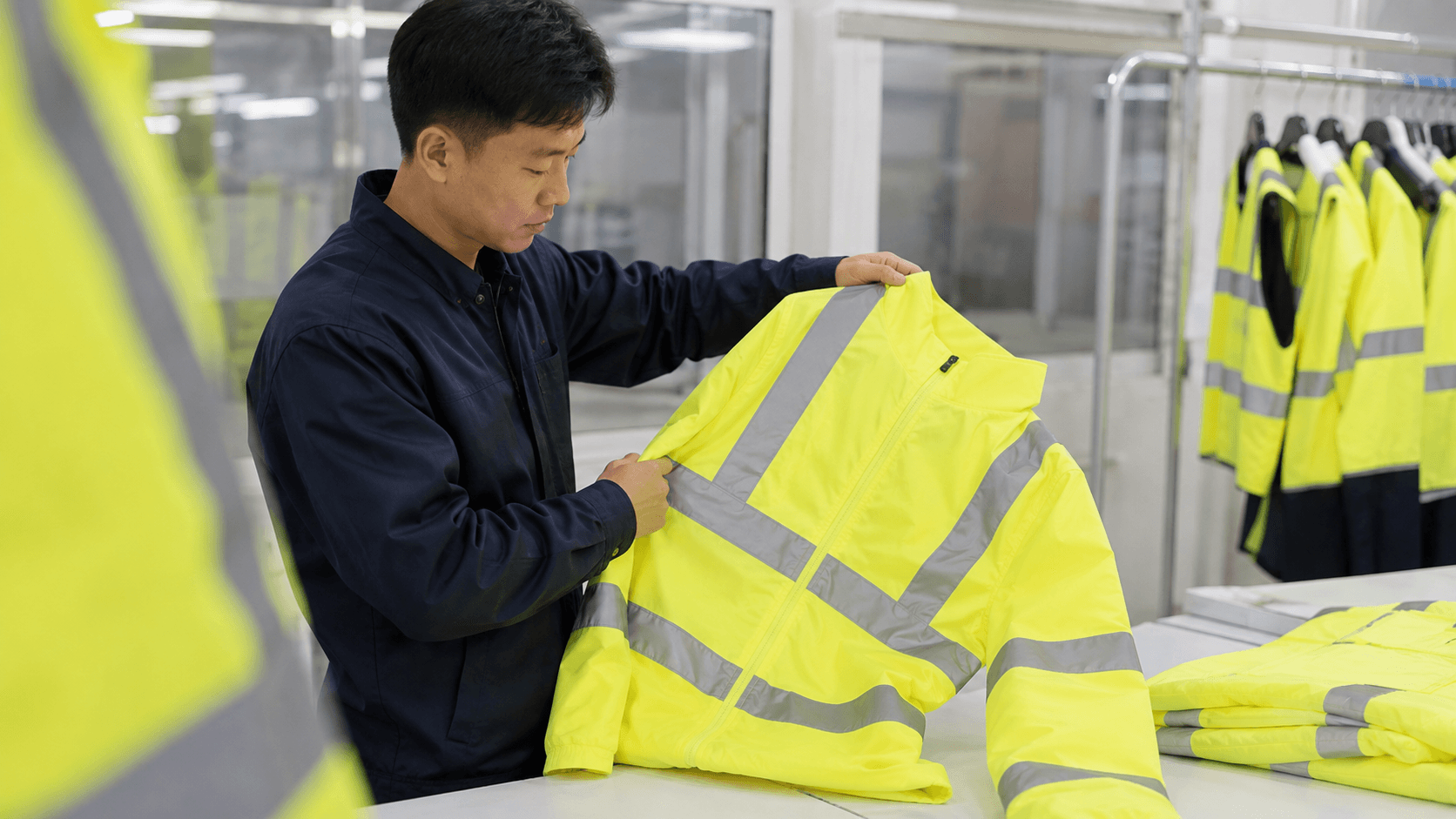
ANSI/ISEA 107 is commonly referenced in North American high-visibility safety apparel specifications. EN ISO 20471 is commonly requested for European markets. Both relate to visibility garments, but the classification, design and conformity requirements should be read from the current customer specification and the supporting product documents. OSHA refers to ANSI 107 for suitable high-visibility garments in work-zone guidance; see its work-zone awareness material.
Do not select a garment by fluorescent colour alone. Visibility depends on background area, reflective material, configuration, wearer movement, ambient light, surrounding traffic, maintenance and correct garment size. Project risk assessment determines what workers need; PPE does not replace traffic separation, lighting or safe work methods.
| Buyer decision | What to write into the specification |
|---|---|
| Market and project | Destination country, client standard and required class |
| Garment style | Vest, jacket, trousers, coverall or weather layer |
| Visibility design | Background colour, contrast material, trim width and placement |
| User needs | Size curve, pockets, radio loops, zip or hook-and-loop closure |
| Brand control | Logo location, approved artwork, label language and barcode |
Start with the work, traffic and weather conditions
Ask the customer where and when the garment will be worn. Day work on a segregated warehouse floor is not the same as night road work, airport ramp activity or a rainy construction site. Photographs of the working environment are useful during specification review. They reveal whether the wearer turns away from traffic, carries a backpack, works in a seated position or must layer the garment over cold-weather clothing.
Do not confuse decoration with conforming trim
Reflective piping, a small printed logo, or a random stripe can look attractive while failing to meet a project requirement. The supplier should provide a drawing showing garment panels and trim placement before sampling. During sample approval, compare the physical sample against that drawing, not only against an online image.
Plan for laundering and replacement
High-visibility performance can change through wear, soil, abrasion and laundering. Care instructions, permitted wash process and replacement criteria should be shared with the end user. For rental or industrial-laundry programmes, ask whether the product construction and trim are suited to that system; do not assume a domestic-care label answers an industrial-laundry question.
Factory testing and shipment inspection
An order should have two layers of evidence. Product conformity evidence supports the intended claim. Production checks confirm the actual delivery matches the approved model. For high-visibility workwear, a shipment inspection commonly reviews:
- Fabric colour and lot consistency against the approved swatch.
- Retroreflective trim width, placement, adhesion or stitching, and visible damage.
- Garment measurements and size labels across the agreed size mix.
- Stitching, zippers, closures, pockets and logo position.
- Care labels, country-of-origin marking, individual packing, carton count and shipping marks.
If the buyer needs independent laboratory testing, arrange samples and timing before production. A report for a similar fabric or a previous colour should not automatically be used for a different product construction. If a substitute fabric, tape supplier or pattern change is proposed, hold a technical review and update the approved sample record.
Compare quotes beyond price per vest
High-visibility garments are a system of materials, workmanship and packing. Request quotes on an identical tech pack. Include garment class, fabric weight if relevant, trim brand/specification where required, logo method, size ratio, packing format, production lead time and quality standard. A low quote may omit a sleeve, lining, contrast panel, closure or requested labelling.
For PPEgen supplier controls, use our reliable PPE supplier guide. If this order ships with other PPE, build carton checks into the pre-shipment inspection plan rather than inspecting only the top carton.
FAQ
Is ANSI/ISEA 107 the same as EN ISO 20471?
No. They are separate standards used in different markets and contracts. Follow the exact client, market and project requirement, and request product-specific conformity evidence.
Can a plain orange vest be called high visibility?
Colour alone does not establish conformity. The material, design, trim configuration, garment class and documentation matter.
What should be approved before bulk production?
Approve the technical drawing, size chart, fabric and trim swatches, logo artwork, labels, packing, pre-production sample and inspection checklist.
Conclusion
Good high-visibility procurement turns a safety requirement into a controlled garment specification. Begin with the work environment, select the requested standard and design, approve a real sample, and inspect the shipment against the same documents. That protects both the wearer and the buyer’s project delivery.
CTA: Ask for a High-Visibility Garment Tech Pack
Send your target market, garment style, project class, logo artwork and quantity. PPEgen can prepare a practical specification checklist for quotation and sample approval.
BUYER RESOURCES
Continue your PPE sourcing research.
Explore relevant PPE categories and a primary safety reference alongside this guide.Use this source alongside destination-market requirements for the exact product and application.
READY TO DISCUSS YOUR REQUIREMENT?