BUYER'S GUIDE - 10 MIN READ
Fall-Arrest Clearance: A Buyer Worksheet Before Ordering Lanyards
Editorial information, sources and corrections
Collect anchor, connector, deceleration, worker and lower-level information before ordering fall-arrest lanyards. Do not guess clearance from lanyard length.

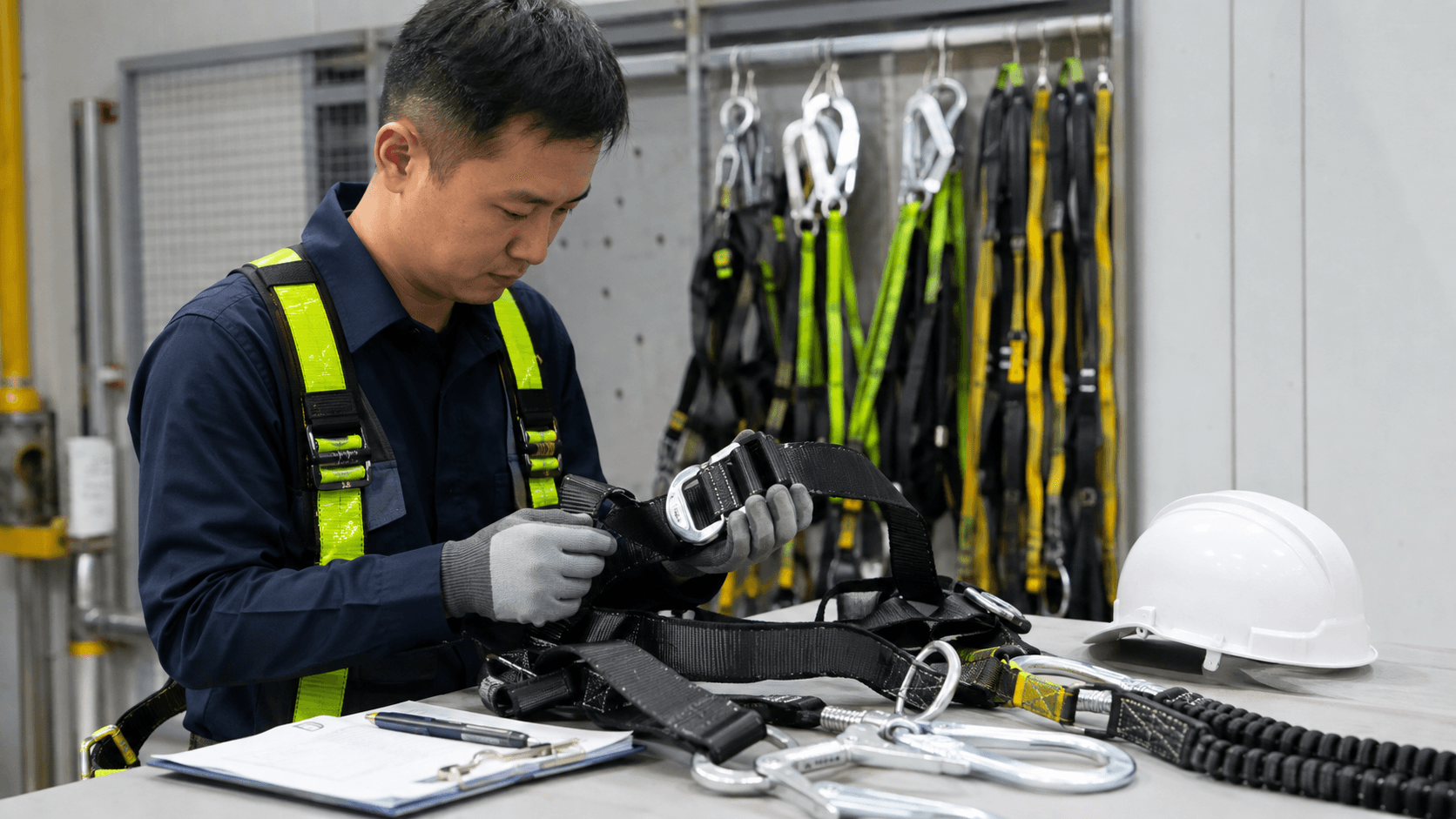
Illustrative image, not evidence of testing or a documented customer project. Procurement guidance does not replace product instructions or competent workplace assessment.
Primary topic: fall arrest clearance buying worksheet
Introduction
One of the riskiest procurement shortcuts in fall protection is choosing a lanyard from its nominal length alone. A fall-arrest system needs sufficient distance to stop a fall before the worker strikes a lower level or obstruction. The required clearance depends on anchor location, free fall, connector and energy-absorber behavior, harness movement, worker dimensions and a safety margin under the applicable design method.
This article is a data-collection worksheet, not a clearance calculator or design approval. The employer's qualified or competent fall-protection personnel must assess the worksite and approve the complete system before equipment is purchased or used.
Quick answer: Do not order an arrest lanyard solely because its length appears shorter than the distance to the ground. Collect the anchor height and position, product-specific deployment/deceleration data, harness and connector details, worker position, swing-fall geometry and lower-level obstacles. Have the responsible specialist calculate clearance and select the system, including alternatives where space is insufficient.
Start with the work-at-height method
The HSE work-at-height guidance emphasizes planning and avoiding work at height where reasonably practicable before relying on personal fall protection. Can the task be done from the ground, a guarded platform or another collective measure? If a personal fall-arrest system remains necessary, the site must have suitable anchors, training, inspection and rescue planning.
The OSHA fall-protection technical manual discusses fall distance and anchorage considerations. Its non-mandatory fall-protection appendix provides technical context, but the buyer must not lift a single number from an example and apply it to every system. Read the actual product instructions and jurisdictional requirements.
Collect the geometry
Record the worker's standing surface, anchor height relative to the dorsal attachment, horizontal offset from the worker, edge location and the nearest lower level or obstruction. Note whether the anchor is overhead, at shoulder height or lower. A low anchor can produce more free fall and different clearance requirements than an overhead one. A horizontal offset introduces swing-fall risk; vertical clearance alone may not describe the whole danger.
Worksheet: site inputs
| Input | Record for each task | Who confirms |
|---|---|---|
| Work surface and edge | Drawing, location and elevation | Site supervisor/safety lead |
| Anchor identity and location | Approved point, height and horizontal offset | Qualified fall-protection person |
| Lower level/obstructions | Nearest surface, equipment, protrusions | Site survey |
| Worker range | Height and equipment-weight scope | Employer program |
| Rescue route | How suspended worker will be reached | Rescue planner |
Do not describe an unverified steel beam or handrail as an "anchor" merely because a hook can connect to it. Anchorage suitability is a technical decision, separate from connector fit.
Collect the equipment inputs
Record harness model, dorsal D-ring position, connector and lanyard type, nominal length, energy absorber deployment limits, any self-retracting device behavior, approved worker weight range and installation/use instructions. Ask suppliers for product-specific information under the standard applicable to the destination. If the system combines brands, the responsible specialist must verify compatibility rather than assume all connectors and energy absorbers are interchangeable.
| Equipment field | Why procurement needs it |
|---|---|
| Exact SKU and revision | Keeps calculation tied to supplied product |
| Connection method | Affects geometry and compatibility |
| Absorber/deceleration information | May add substantial stopping distance |
| Worker-weight range | Product limits may vary |
| Harness instructions | Attachment and fit change system behavior |
| Inspection and rescue instructions | Required for ongoing program |
A product can be well made and still be wrong for a low-clearance task. The purpose of this worksheet is to reveal that mismatch before an order is placed.
Mid-article CTA — Send Your Requirements: Share your task drawing, approved anchor information, worker range and required destination standard with PPEgen. We can provide exact equipment documents for your qualified fall-protection reviewer—without claiming to design the site system. Contact us.
Have the responsible person calculate and approve
The site specialist should use the correct method for the actual system, include manufacturer-required margins and consider swing falls and lower obstructions. Avoid an internet formula that assumes the same absorber extension or anchor position for every product. A numerical result should be retained with the drawing, equipment SKU and assumptions so later substitutions can be reviewed.
If clearance is inadequate, do not shorten an energy-absorbing lanyard by tying knots or moving to an unapproved anchor. Reassess the work method, guardrails, positioning, restraint or other engineered options as appropriate. The decision belongs to qualified personnel and may change the equipment category entirely.
An illustrative scenario: a buyer requests a standard-length energy-absorbing lanyard for a mezzanine with equipment below. The quote looks reasonable, but the anchor is below shoulder height and the lower obstruction is close. Procurement holds the order until the site calculates clearance and considers an alternative system. This is a hypothetical example, not a claim about PPEgen equipment.
Preserve the approved system through shipment
Write exact model, length, connector type, standard, worker range, packaging and documents into the PO. Require approval before any substitution. At receiving, compare delivered labels, instructions, lot information and connectors against the approved schedule. A visually similar lanyard may have a different absorber or connector that changes the clearance analysis.
Inspect equipment under the manufacturer's instructions before issue and during service. Keep impact-loaded or suspect components out of circulation. The fall-arrest harness receiving guide addresses incoming control, while the harness inspection checklist covers ongoing checks. The fall-protection category is a commercial starting point only.
Turn the site drawing into a controlled request
Procurement often receives a verbal request for "a lanyard for the new platform." Instead, ask for a dated drawing or annotated photograph showing the work surface, edge, intended anchor and closest lower obstruction. The qualified reviewer should identify which geometry is worst case and whether workers move along the edge. Record changes in elevation, obstructions and anchor location. If the area has multiple tasks, one clearance calculation may not cover them all.
Keep the drawing linked to the equipment schedule. A later change in machine height, guardrail location or anchor beam can invalidate the original assumptions even if the lanyard SKU remains the same. Similarly, a new lanyard with a different energy absorber or connector may change the calculation even if the work platform does not. Version control is therefore a safety measure, not just a document-management preference.
Ask how a swing fall is considered
If the anchor is horizontally offset, a falling worker may swing toward a structure. A simple vertical measurement to the floor will not describe the potential contact. The responsible person should assess the geometry, limit travel where necessary and choose appropriate equipment and anchors. Procurement can ask for the approved configuration and required anchor positions; it should not estimate swing trajectories from a product photo.
Rescue planning belongs in the same review. A system that stops a fall is not complete if the employer lacks a timely rescue method appropriate to the location. Ask what rescue equipment, training or access arrangements the site requires before placing an order for only the arrest components. Do not treat a generic rescue-kit SKU as proof that the rescue plan is workable.
Compare system offers, not individual hooks
For each offer, list harness, lanyard or self-retracting device, connector, anchor component, compatible accessories, worker-weight range, applicable standard, instructions, inspection method and spare parts. Obtain product-specific deployment or stopping-distance information needed by the reviewer. The cheapest lanyard is not comparable to a complete approved system if it omits a compatible anchor connector or changes the free-fall assumptions.
The supplier may offer an alternate connector because it is in stock. Ask the qualified reviewer to check gate orientation, connection restrictions and compatibility with the anchor and harness. A hook that clips on is not automatically compatible. Keep the approved configuration on the purchase order and carton inspection sheet so the warehouse does not make its own substitution decision.
Commissioning and user training
Before first use, the site should check anchor identification, equipment labels, inspection status, fit and training records. Users need to know the permitted connection points and limits. Procurement can deliver the instructions and traceability documentation, but technical commissioning is the employer's responsibility. Store equipment under the maker's conditions and keep damaged or impacted components quarantined.
An illustrative control measure is a tag on each approved kit listing the system ID and permitted task area, plus a separate record containing the clearance assessment. The tag is not a substitute for training; it makes it harder to move a kit casually to a lower-clearance area. This is a workflow example, not a claim about a specific customer installation.
Use field feedback to improve future requests
Track which systems are withdrawn for damage, which connectors are difficult to use and where workers report poor fit. Investigate whether the issue comes from training, task design or product selection. Do not solve a convenience complaint by removing an energy absorber or using an unapproved anchor. Return findings to the qualified reviewer and update the specification only after technical approval.
At replenishment, confirm the same model and version remain available. If not, treat the new product as a fresh clearance and compatibility review. Keep lot and serial information for affected components so notices or recalls can be addressed efficiently.
FAQ
Is a six-foot lanyard safe whenever the platform is more than six feet high?
No. Clearance includes more than nominal lanyard length, and anchor position and lower obstructions matter. A qualified person must assess the full system.
Can a low anchor increase the required clearance?
Yes, it can change free-fall geometry. Obtain a task-specific calculation under the applicable method and equipment instructions.
Can two brands of harness and lanyard be combined?
Only after compatibility is established by the responsible technical program under product instructions and applicable rules. Matching hooks by appearance is insufficient.
What if there is no adequate clearance?
Stop the assumed purchase and consider a different work method or approved protective system with qualified personnel. Do not improvise a shorter lanyard.
What should buyers ask the supplier for?
Exact SKU, standard and classification, product-specific deployment data, worker range, connector details, instructions and lot traceability.
Can procurement use a manufacturer's sample diagram as the site calculation?
No. A diagram illustrates one configuration and assumptions. The site's anchor height, worker position, equipment and obstructions may differ. The qualified reviewer can use manufacturer data in an actual calculation, but procurement should retain the site-specific drawing and decision. A catalog diagram is valuable for asking the right questions; it is not a sign-off for a different mezzanine or roof edge.
What changes require the worksheet to be revisited?
A new anchor, altered work platform, added lower-level equipment, different lanyard or absorber, changed worker-weight range and a different harness attachment can all be material. Even moving the same job to another end of a roof can change swing-fall geometry. Make the worksheet a controlled record tied to task location and equipment IDs rather than a one-time note filed under "fall PPE."
For a contractor working at several client sites, keep separate clearance records by location and task. The same harness and lanyard may be approved at one site but unsuitable at another with lower structures or a different anchor. Do not put a universal "approved for all sites" stamp on a kit unless the responsible reviewer has established that scope. A central equipment register can show model and inspection status while site-specific worksheets show geometry and permitted configurations.
Ask how the system will be inspected after transport and between users. Dirt, abrasion, altered connectors or missing instructions can affect safe use. The employer's inspection and training process must address those conditions. Procurement should provide traceable replacement stock and preserve the approved model numbers so an urgent repair does not result in an unreviewed component change.
What should accompany the equipment shipment?
Include the exact-model user instructions, labels, inspection guidance and traceability information required by the order and destination. Keep the approved system schedule separate from a supplier's generic catalog. The site reviewer may need product-specific data to reconfirm clearance after a design or anchor change. If those documents are missing at receipt, quarantine the affected components until they can be reconciled. Procurement should not interpret a carton marked "fall protection" as proof that the items match the approved calculation. The warehouse can check identifiers and condition; only qualified personnel should approve the site-specific use configuration.
Conclusion
Fall-arrest clearance is a system calculation grounded in site geometry and product data. The buyer can make the process safer by collecting accurate inputs, refusing unsupported substitutions and involving the qualified reviewer before ordering. Nominal lanyard length is only one input, never the complete answer.
Final CTA — Get a Quote: Send approved equipment specifications and the reviewer’s data request to info@ppegen.com. PPEgen can provide model-specific quotation and documentation for your site's decision.
BUYER RESOURCES
Continue your PPE sourcing research.
Explore relevant PPE categories and a primary safety reference alongside this guide.Use this source alongside destination-market requirements for the exact product and application.
READY TO DISCUSS YOUR REQUIREMENT?