BUYER'S GUIDE - 11 MIN READ
Heat-Resistant Work Gloves: Contact-Heat Selection for Industrial Buyers
Editorial information, sources and corrections
Specify heat-protective gloves for the actual contact task. Compare evidence, grip, fit, cuffs and sample approval before bulk purchasing.

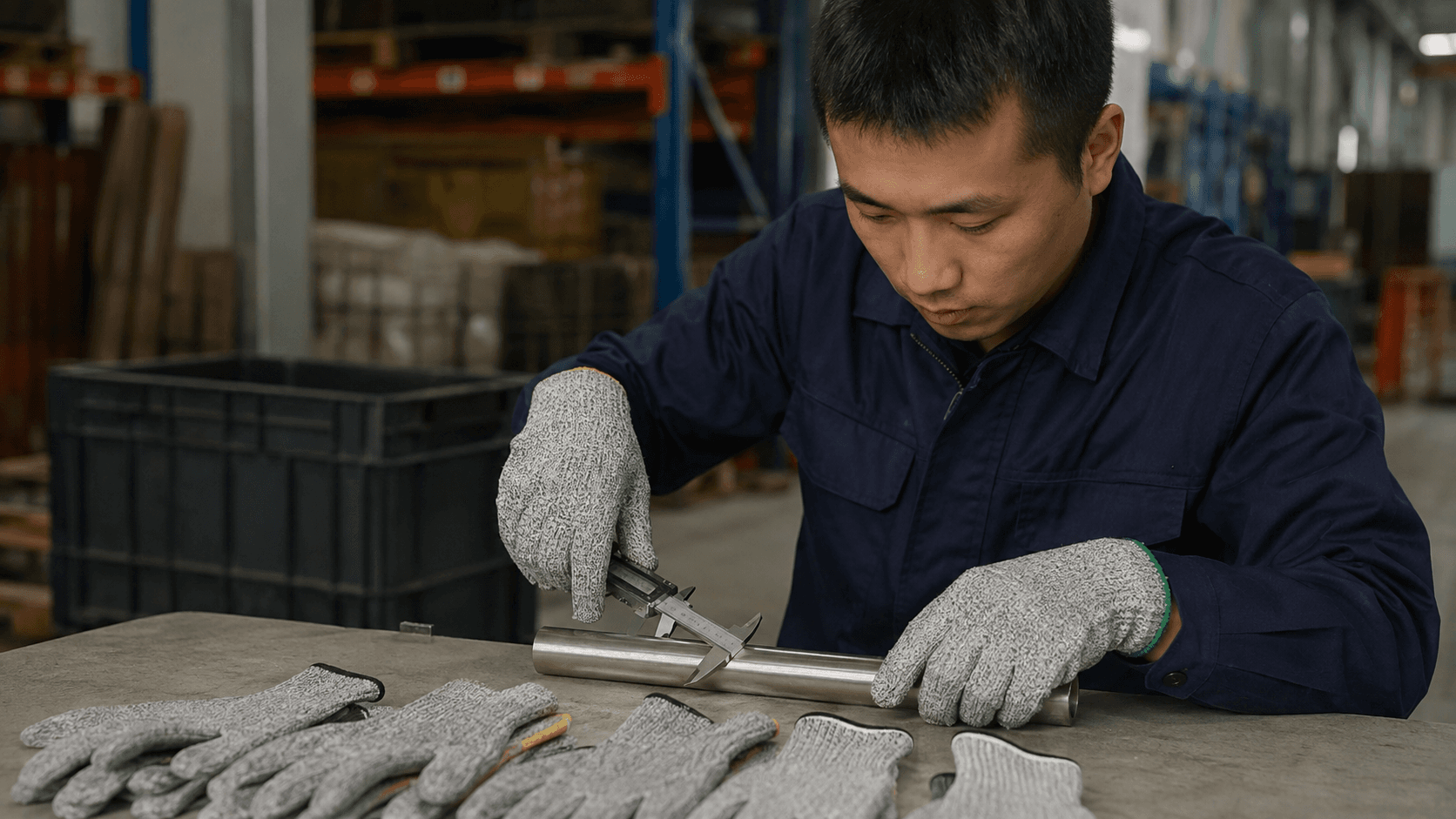
Illustrative image, not evidence of testing or a documented customer project. Procurement guidance does not replace product instructions or competent workplace assessment.
Primary topic: contact heat glove selection for buyers
Introduction
"Heat-resistant gloves" is not enough information to approve a bulk order. A worker briefly gripping a hot metal component, reaching near radiant heat and handling an intermittently warm carton face different exposures. The acceptable glove depends on the assessed task, temperature and contact pattern, but also on secure grip, hand movement, fit, cuff coverage and the applicable evidence for the exact product.
This guide is for industrial purchasing teams and PPE importers preparing a specification with a competent safety lead. It does not provide a temperature/time table that makes a glove safe in every workplace. The goal is to separate the heat mode from other hand hazards and make supplier claims inspectable.
Quick answer: For contact-heat work, define the object, surface condition, contact duration and number of repeated contacts. Ask for test evidence under the relevant method and edition for the exact glove, then review grip, dexterity, wear, cuff and other hazards. Approve a safe, supervised sample trial and keep the model and instructions linked to the order.
Identify the heat mode rather than buying an adjective
Contact heat arises when the glove touches an object. Convective heat and radiant heat describe other pathways. A glove promoted for one pathway may not be appropriate for another. The site's safety lead must assess the actual exposure, including any potential for flame or molten material. Do not treat a generic "high-temperature" marketing phrase as evidence for all these hazards.
The Health and Safety Executive's glove guidance tells employers to identify other hand hazards and notes that thermal claims may be separately marked. The OSHA hand-protection standard likewise frames glove selection around the nature of the work and identified risks. Together, these sources support an application-first purchasing conversation.
Ask the site for a contact description
What material is handled? Is the hot surface smooth, oily, rough or edged? How long does a typical touch last, and how often is it repeated? Is the object carried, rotated, pressed or put down? Are handles or tools available to remove direct contact? These details change both glove performance needs and safe work practices.
Record the expected range as assessed by the workplace rather than borrowing a number from a supplier brochure. Temperature alone is not a full description. Surface mass, pressure, moisture and the way a worker grips can influence heat transfer and injury risk. A compact ceramic piece, a hot steel sheet and a heated handle should not be merged into one work instruction because they share a nominal temperature.
Map the non-thermal hazards in the same task
Hot objects may have sharp edges, burrs, pinch points or residues. A glove's thermal claim does not prove cut, puncture or chemical suitability. Conversely, a cut-resistant liner does not establish acceptable contact-heat protection. Where both hazards matter, ask for supporting evidence for each relevant property in the exact combined construction.
Our cut-resistant glove guide helps buyers describe edge-handling requirements separately. The two articles should be combined into one approved task specification, not two competing claims on a sales sheet.
Record the whole wearing arrangement
Will workers wear a sleeve, jacket cuff or apron with the glove? Will the glove be removed frequently? Does cuff length affect entry of hot fragments or interfere with movement? The site's assessor should define permitted interfaces. A longer cuff might be useful for one hazard and cumbersome for another; it is not universally safer.
Glove size and hand fatigue matter as well. A heavily insulated glove can reduce tactile feedback and precision. If a worker needs fine control, the buyer may need a redesigned handling process or a different approved glove rather than asking the operator to work faster in an unwieldy sample.
Read thermal evidence without converting it into a universal safe-contact time
Request the product's stated standard, edition, test method, measured or classified result and limitations. Identify whether the evidence covers the finished glove, the palm material, a sample coupon or a product family. If multiple parts of the glove are constructed differently, ask which surface was evaluated and which part actually contacts the hot object.
The supplier should explain the rating in its own applicable framework. Do not create a table that says a particular label makes any hot item safe to hold for a fixed number of seconds. Laboratory conditions do not reproduce every real object, repeated contact sequence, pressure and contamination. The employer's competent reviewer must determine the acceptable task procedure.
| Buyer question | Evidence or observation to seek | Decision owner |
|---|---|---|
| Which heat pathway is present? | Site hazard assessment and task description | Employer's safety lead |
| What does the glove claim cover? | Exact-model method, edition, result and instructions | Supplier plus technical reviewer |
| Can the worker handle the item safely? | Controlled, non-hazardous sample review and approved task trial | Employer's assessor |
| How will condition be checked? | Manufacturer care and replacement instructions | Employer's PPE program |
| Can the lot be reproduced? | Approved sample, revision and shipment inspection plan | Buyer and supplier |
The HSE guide to using the right PPE highlights the need for appropriate selection, care and training. A test classification helps narrow options; it does not replace those operational decisions.
Compare materials and construction without pretending one wins everywhere
Many thermal gloves use multiple layers or coated surfaces. Ask the supplier to identify the outer material, insulation, liner, seam location, cuff, finish and sizes. A palm patch may change grip and durability. A seam positioned on a contact area may create a local issue even if a flat material sample looks promising. Confirm how the final construction is represented in the evidence and approved sample.
Surface texture affects the ability to retain an object. The site should determine whether slipping a hot item would create an additional hazard. Request sample photographs of both palm and back, plus close-ups of grip areas and stitching. These images help specify construction; they are not performance tests.
Review moisture and cleaning instructions
Moisture can change comfort and heat-transfer conditions. If the task involves wet parts or frequent laundering, obtain instructions for that exact model and discuss their implications with the safety reviewer. Do not assume a dry glove rating applies unchanged after saturation or a cleaning process that the manufacturer has not permitted.
A glove that cannot be cleaned as the site intends may need a different issue strategy. The buyer can estimate consumption only after the site defines permitted use and replacement triggers. Treat a marketing promise of unlimited reuse as unverified unless the manufacturer provides relevant support.
Plan a safe sample approval
Start with product identity, size range, construction and documents. In a hazard-free setting, have representative wearers try hand movements and grips using unheated or otherwise safe sample objects. Record any loss of control, interference, fatigue or cuff movement. If a controlled assessment of hot work is needed, the workplace must design and supervise it under its safety procedure; purchasing should not improvise it for a sales demonstration.
Our PPE sample approval checklist provides a record structure. State exactly what each trial did and did not establish. A worker saying the glove feels comfortable does not validate a thermal protection claim. A laboratory result does not prove the worker can grip the actual component securely.
Define acceptance before viewing candidate prices
Create an approval matrix with columns for required heat mode, evidence, secondary hazards, fit and grip, cuff/interface, permitted cleaning, sizes, label and price unit. Set mandatory criteria with the technical reviewer. A candidate that lacks a required property should be marked pending, not quietly moved to the low-price shortlist.
For illustration, a buyer may find Candidate A fits small-handed workers but is too bulky for a fine assembly step, while Candidate B permits movement but lacks requested documentation for the expected heat mode. Neither observation proves either glove unsafe or safe in every context. The logical next step is to resolve the missing evidence or adjust the task process, not invent a winner from a two-column price comparison.
Specify the shipment and repeat order
The RFQ should state the approved model/revision, needed thermal and other properties, construction, sizes, pack units, carton marks, market, documentation and estimated quantity. Ask suppliers to identify any deviations at quotation. If the work is seasonal or conducted at several sites, separate configurations instead of assuming one glove covers every location.
The PPE quotation-unit guide is useful for comparing pairs, pieces and cartons. For example, 250 packs of 12 pairs equal 3,000 pairs; that arithmetic says nothing about thermal suitability. Put the calculation after the approved protection decision.
Mid-article CTA: request a task-specific shortlist
If you are sourcing thermal hand protection, send your requirements with the assessed heat mode, part description, secondary hazards, sizes, destination market and quantity. Ask for exact-model evidence and sample options. PPEgen can organize a quotation; only the qualified workplace review can approve the application.
Before shipment, check the delivered glove against the approved sample: material, layer arrangement where visible, seams, cuff, markings, sizes, pair matching and pack count. Confirm that required instructions and evidence correspond to the ordered model. A visual pre-shipment check does not recreate a contact-heat laboratory test. Hold unexplained substitutions for technical review.
Review cost without replacing evidence with price
Compare technically acceptable candidates using the same quotation unit and conditions. A glove's purchase price may be higher because of construction, size mix, packing or test support. Any cost-per-use estimate needs actual issue and replacement data from the defined task. Do not divide price by an assumed number of safe hot contacts.
For illustration, a USD 6.00 pair and a USD 8.00 pair differ by USD 2.00 at purchase. If one has a different carton minimum or cleaning instruction, normalize those terms separately. These figures illustrate arithmetic, not current market prices or evidence that the more expensive pair protects better.
Maintain a replacement record after rollout: model, user group, task, observed wear, permitted cleaning and reason for withdrawal. If the process changes or the glove is exposed to a new material, recheck the hazard assessment and supplier evidence. The approved order should not become a permanent one-size-fits-all promise.
FAQ
Does a heat-resistant label mean a glove protects against flame?
No. "Heat resistant" can conceal different test categories and conditions. Ask which thermal pathway the exact glove was evaluated for and request its instructions. Contact with hot objects, radiant heat and flame are not interchangeable. The site's competent safety reviewer must match the documented claim to the task and other controls.
Can I specify a maximum safe temperature and holding time from a catalog?
Not as a universal instruction. A published test result arises under defined conditions that may not match the object's mass, surface, pressure, repeat contact or glove condition. Obtain the actual method and model-specific data, then have the workplace reviewer determine an approved procedure. Do not turn a catalog table into a blanket safe-contact rule.
Should the thickest thermal glove be ordered for everyone?
Not automatically. Insulation can affect dexterity, grip and fatigue. The candidate must meet the task's protection requirement while allowing a safe method of handling. Representative fit and movement review may reveal a need for multiple approved sizes or a changed tool. Thickness alone is not an evidence-based purchasing criterion.
How should thermal gloves be checked before shipment?
Compare the delivered lot with the accepted sample and purchase specification: model, visible construction, seam placement, cuff, sizes, pair matching, marking, documentation and packing. Use the agreed inspection plan. Factory or shipment visual checks support consistency; they do not establish a thermal test result for a changed construction.
What if the buyer also needs cut resistance?
Request separate supporting evidence for the relevant mechanical and thermal properties in the offered configuration. Describe the hot object's edges and the handling motion to the site safety lead. Do not infer cut protection from an insulated appearance or thermal performance from a cut label. Confirm fit and grip for the combined task.
For repeat orders, ask whether the liner, palm material or seam construction changed since the approved sample. A change in visible stitching can be a prompt for technical review, not merely a cosmetic issue. Keep the task description and exact-model evidence together so a future buyer does not purchase a visually similar glove for a different heat pathway.
How should a sample be recorded after a safe trial?
Note the exact glove model and size, liner and cuff, the nonhazardous trial task, wearer feedback on grip and dexterity, and any visible wear. Keep the accepted sample separately from production stock. The technical reviewer should connect it to the heat evidence and the assessed task; procurement should not state that the sample "passed heat testing" merely because users handled an unheated part comfortably. If a later production lot changes palm material, seam location or insulation thickness, compare it with the accepted sample and ask whether the supporting claim still applies.
Conclusion
Contact-heat glove selection starts with a defined exposure and ends with a reproducible product specification. Identify the heat pathway, secondary hazards and wearing system; review exact-model evidence; approve fit and grip safely; and control construction through shipment and repeat orders. Avoid universal temperature promises from a single label.
Request heat-glove samples
Explore PPEgen safety gloves or send a quote request. Provide the assessed task, hot-part description, other hand hazards, required documents, sizes and order quantity. We can help structure the supplier response without replacing the employer's technical approval.
BUYER RESOURCES
Continue your PPE sourcing research.
Explore relevant PPE categories and a primary safety reference alongside this guide.Use this source alongside destination-market requirements for the exact product and application.
READY TO DISCUSS YOUR REQUIREMENT?