BUYER'S GUIDE - 12 MIN READ
How Should Safety Gloves Be Inspected, Cleaned, Stored and Replaced?
Editorial information, sources and corrections
Build a practical safety glove care program with inspection points, cleaning limits, storage controls and replacement decisions for industrial purchasing.
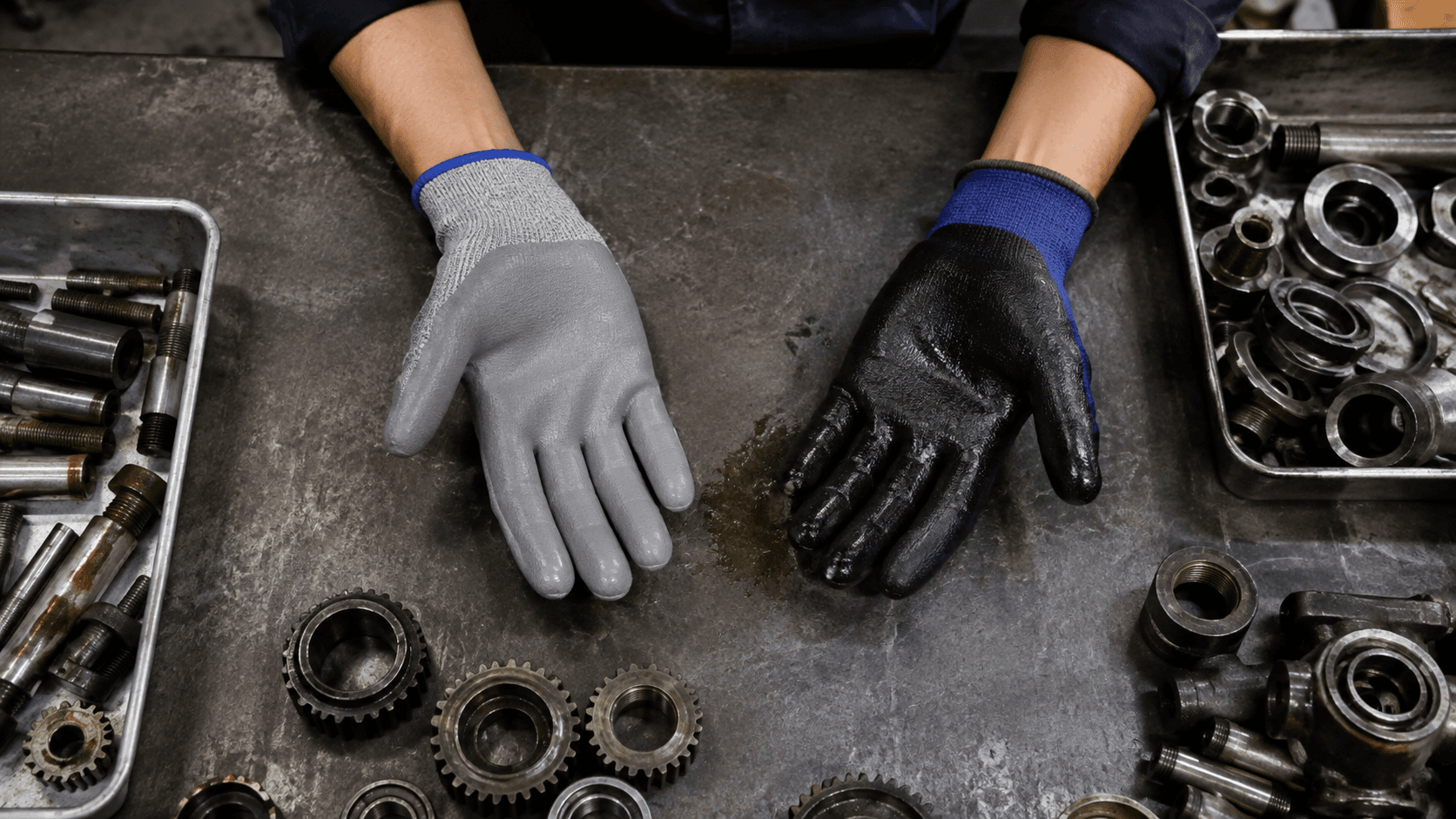
Illustrative image, not evidence of testing or a documented customer project. Procurement guidance does not replace product instructions or competent workplace assessment.
Primary topic: safety gloves inspection cleaning storage replacement
Introduction
Inspect safety gloves before use, clean them only by a method authorized for the exact model, store usable pairs away from contamination, and replace them when their condition or exposure history no longer supports safe use. There is no universal replacement interval for every glove, coating and task. A pair that still looks presentable may be unsuitable after chemical exposure, while a washable mechanical glove may remain serviceable after a controlled cleaning cycle.
For purchasing teams, glove care is therefore a supply specification, not merely a housekeeping instruction. The order should establish whether the glove is disposable or reusable, what care information accompanies it, how replacement stock will be issued and who can release cleaned gloves back into service. This guide explains how to turn those decisions into a workable program without inventing a fixed service life or treating washing as proof of restored protection.
Start with a model-specific care file
Create one record for each approved glove model. Include the manufacturer, model code, sizes, intended tasks, restrictions, relevant instructions, storage conditions and approved cleaning method. Keep a revision date so a supplier's updated leaflet does not silently change the site's procedure. A distributor's general laundry poster is not sufficient if several constructions are issued under the same purchasing category.
Ask specifically whether the published performance information applies to new gloves only or includes any stated cleaning pretreatment. A test involving laboratory laundering does not automatically validate your laundry contractor's detergent, water, machinery and contamination load. Record what the evidence actually says. Where it is silent, seek a written explanation rather than assuming that the rating is unaffected indefinitely.
Separate three questions: can the material tolerate cleaning, can the contamination be removed safely, and is the resulting glove still suitable for its assigned task? A positive answer to the first question does not settle the other two. This distinction prevents a reusable construction from becoming an excuse to reuse gloves after every type of exposure.
Inspect before issue and before each use
Check the exterior in a safe area
Handle only gloves that are safe to inspect under the site's contamination procedure. With a new or appropriately cleaned pair, examine the palm, fingertips, thumb web, seams and cuff in adequate light. Look for exposed liner, coating separation, holes, cuts, unusual stiffness, sticky areas, distortion and embedded debris. Compare questionable areas with an unused approved reference pair rather than relying on memory.
Different constructions fail in different ways. A dipped knit glove may show coating wear at the fingertips. A sewn glove may develop seam damage. A lined gauntlet may retain contamination inside a fold. The inspection card should identify the actual model's vulnerable locations; an undifferentiated instruction to check for damage is too vague for consistent decisions.
Check fit and internal condition
A glove can remain physically intact while becoming unsuitable because its shape has changed. Check whether the fingers seat correctly, the cuff stays in position and the hand can move without unusual restriction. Do not stretch a shrunken glove back into service by force. Equally, a loose cuff should not be repaired with an improvised fastener that creates a new snag point.
Internal grit, dampness or contamination requires a decision before donning. Do not insert an unprotected hand into a glove with unknown residues to investigate it. Report the condition and follow the appropriate handling procedure. The person checking stock should have access to the instructions and a clearly marked quarantine location, not be expected to diagnose contamination by smell.
Use a clear decision table
| Observation | Immediate response | Follow-up decision |
|---|---|---|
| Visible tear, hole or damaged protective area | Remove the pair from use | Replace; investigate the task if failures recur |
| Unknown chemical exposure | Isolate under the site's contamination procedure | Obtain competent advice; appearance cannot establish safety |
| Cleaning method or history unknown | Do not automatically reissue | Resolve history or replace according to the risk assessment |
| Unreadable model or size identification | Separate from approved stock | Restore traceability only with reliable records |
| Damp interior after an approved wash | Hold out of service | Complete authorized drying and reinspect |
| Glove no longer fits correctly | Stop using that pair for the task | Check cleaning effects and issue a suitable size |
This table is a purchasing and supervision aid, not a substitute for the manufacturer's instructions. Add task-specific rejection criteria where a competent assessment requires them. Avoid terms such as acceptable minor damage unless someone has defined exactly what they mean and why they do not compromise the relevant protective function.
Distinguish cleaning from decontamination
Cleaning removes soil. It does not necessarily establish that a hazardous substance has been removed from the glove material. A surface that looks clean may retain contamination, and a chemical can affect a glove without producing an obvious hole. For chemical tasks, replacement and reuse decisions need model-specific manufacturer advice and the actual substance, concentration, temperature and contact conditions.
Do not convert a laboratory breakthrough result into a washing schedule or a guaranteed wearing time. Likewise, a disinfectant suitable for a workbench is not automatically suitable for a protective glove. A cleaning chemical, heat treatment or solvent can introduce a separate compatibility problem. These are reasons to obtain instructions, not to perform informal experiments while wearing the gloves.
As a narrow manufacturer example, Ansell's guidance on washing cut-resistant gloves separates care according to material family and emphasizes following manufacturer instructions. Its procedures should not be copied to an unrelated PPEgen-sourced model without confirmation. The transferable lesson is the need for a defined process, not a universal temperature or detergent recommendation.
Control reusable-glove laundering
Agree the process before approving reuse
Specify the model, permitted contamination, detergent, washing and drying conditions, segregation requirements and rejection criteria with the manufacturer and laundry provider. Where instructions limit cleaning cycles, provide a practical way to track them. If tracking cannot be maintained, the purchasing decision should reflect that limitation rather than assuming the limit is never reached.
Do not combine unknown gloves in a single laundry batch merely because they share a similar color. Liners, coatings and reinforcements can differ. Keep contaminated collections separate from clean stock and prevent residues from transferring to unrelated clothing or household laundry. The site should determine the appropriate handling and disposal arrangements for its substances and local requirements.
Validate the handover back to the user
Returned gloves should have a defined acceptance check for condition, cleanliness, dryness, identity and fit. Decide who records rejection quantities and whether left and right gloves remain paired. If a laundry provider mixes sizes or models, a low wash price can create significant sorting work and uncertainty at issue.
For a new program, begin with a controlled evaluation of the authorized process. Record the starting model and condition, the process used and the outcome. Do not describe this operational review as certified performance testing. Where retained protection needs laboratory confirmation, agree an appropriate test plan with qualified specialists rather than inferring a rating from a visual inspection.
Send Your Requirements to PPEgen with the glove model, work task, contamination type and proposed cleaning arrangement. Request available care instructions and replacement options before approving a reusable-glove purchasing program.
Design storage around condition, not convenience
Set up separate locations for unopened stock, clean issued gloves, used gloves awaiting a decision and rejected material. An unlabeled basket beside a workstation invites workers to select a pair without knowing its status. A simple location code and clear ownership can be more useful than an elaborate system nobody maintains.
Follow the model's stated storage conditions and shelf-life information where supplied. Avoid treating a vehicle dashboard, wet locker or open chemical store as equivalent to an approved storeroom. Protect packaging and identification from damage. For gloves with an expiry date, issue stock using a documented rotation method that considers expiry, not just the date cartons arrived.
The HSE maintenance guidance emphasizes suitable storage, maintenance responsibility and replacement availability. In a glove program, apply that principle by assigning an owner to each handover: warehouse receipt, workplace issue, collection, cleaning and rejection. Gaps between these steps are where questionable pairs often return to service.
Set replacement triggers instead of invented lifetimes
There are several different clocks: shelf life before use, any manufacturer maximum use limit, a site-defined exposure schedule and the point at which inspection identifies damage. The earliest applicable limit governs. A purchasing spreadsheet should not collapse them into a single statement such as replace monthly without explaining its basis.
For general mechanical work, track why gloves are replaced: abrasion, cuts, lost grip, poor fit, contamination or loss. This helps distinguish a product-selection problem from an issue-management problem. Repeated fingertip failures on one operation may justify revisiting the task and glove specification. It does not justify extending use until the rest of the glove looks equally worn.
For disposable gloves, establish the task-specific change points and removal process through the risk assessment and instructions. Do not add washing or disinfection as an unofficial reuse step. For specialist gloves, including electrical or other high-consequence applications, use the applicable inspection and testing program; this general guide does not replace it.
Build replacement stock into the purchasing plan
A sound rejection rule fails if no suitable replacement is available. Maintain the approved size range at the point of need and define how staff obtain a replacement without unnecessary delay. Stocking only the most common size can turn a correct rejection into an unsafe substitution. Track shortages separately from normal consumption so procurement can address the real cause.
Use service-life observations cautiously. Record the operation, shift pattern, model, reason for replacement and cleaning history. Comparing pairs consumed per week across two sites is misleading when the work and reporting practices differ. A useful measure is the quantity used for a defined task over an observed period, accompanied by the reasons and limitations of the data.
For a broader purchasing comparison, see what drives safety glove price differences. A more expensive washable model is not automatically cheaper overall. Include collection, laundry, inspection, rejected returns, reserve stock and administration before deciding that reuse produces a commercial benefit.
A hypothetical workshop implementation
Consider a workshop with clean assembly work and a separate maintenance area handling unknown residues. It currently places all used coated gloves in one collection bin. The proposed improvement is not simply to wash the contents. First, the safety team separates the tasks and confirms which exact models and contamination categories may enter an authorized cleaning process.
The clean assembly area receives a labeled collection route, while questionable maintenance gloves follow a separate assessment and disposal route. The store keeps unused reference samples and records returned quantities by size. A named reviewer checks cleaned pairs before reissue. Workers are told that returning a damaged pair will not delay access to a replacement.
After the trial, procurement reviews sorting time, rejects and wearer feedback alongside purchase cost. This example is illustrative, not a PPEgen customer case or evidence of a particular glove's durability. Its purpose is to show how condition control, traceability and stock availability work together. A different workplace may reasonably choose single-use replacement instead.
Train people on the decisions they actually make
Training should show the real approved glove, its rejection examples, where replacements are held and how to report an uncertain condition. Avoid relying solely on a generic poster. A worker should know whether a pair belongs in clean storage, a used-glove container or a controlled waste route without improvising.
Review the program when a task, chemical, glove model, cleaning provider or process changes. Supplier substitution is especially important: a visually similar coating may come with different care instructions. Link the maintenance record to the safety glove receiving inspection checklist so replacement shipments do not bypass model verification.
Before expanding the program to another department, check that its collection and issue arrangements are genuinely comparable. A successful process in a clean assembly area does not establish suitability for solvent cleaning, outdoor maintenance or food handling. Keep a short change log recording the department, approved tasks, glove model, care instruction revision and responsible reviewer. This makes it possible to explain why a returned pair was accepted or rejected without relying on informal recollection. It also helps a replacement supervisor maintain the same standard when the original program owner is absent. Good records support consistent decisions; they do not turn an unsuitable cleaning method into a safe one.
FAQ
Can all cut-resistant gloves be washed?
No. Use the instructions for the exact model and contamination involved. A washable liner does not prove that every coating, reinforcement or residue is suitable for the same process. Where no clear care instruction is available, ask the supplier before building laundering into the purchase decision.
Does washing restore the original protection rating?
Not by itself. Washing is not a performance test and cannot repair damaged protective components. Ask what evidence supports any claim about performance after cleaning, including the process and number of cycles. Continue inspecting gloves after each authorized cleaning cycle.
How often should warehouse gloves be replaced?
There is no single interval for all warehouse operations. Consider the model's instructions, actual handling tasks, contamination, condition and any established use limits. Keep replacement stock available and record recurring failure patterns instead of relying on a calendar alone.
Can two workers share reusable gloves?
Do not assume that a shared pair is suitable merely because both workers wear the same nominal size. The program must address hygiene, contamination, fit, inspection and responsibility. Individually assigned gloves can simplify these controls, but the decision depends on the task and approved care arrangements.
What should be included in a care-related supplier inquiry?
Provide the exact model or required construction, task, contaminants, proposed cleaning method, size range and expected issue pattern. Request current instructions, storage information, reuse limitations and any relevant supporting evidence. Avoid asking the supplier to guarantee a service life without describing actual conditions.
Conclusion
A reliable safety glove maintenance program keeps identity, condition and exposure history connected. Inspect before use, control any authorized cleaning, separate usable and questionable stock, and replace gloves whenever the applicable limit or rejection criterion is reached. Purchasing decisions should make these actions easy to perform, not depend on workers stretching a pair's life because stock is unavailable.
Ask for Product Catalog or email info@ppegen.com with your application and glove care requirements. PPEgen can use that information to discuss suitable sourcing options and the documentation you need for your own approval process.
BUYER RESOURCES
Continue your PPE sourcing research.
Explore relevant PPE categories and a primary safety reference alongside this guide.Use this source alongside destination-market requirements for the exact product and application.
READY TO DISCUSS YOUR REQUIREMENT?