BUYER'S GUIDE - 12 MIN READ
Latex vs Nitrile Grip for Wet Construction Tasks: A Procurement Guide
Editorial information, sources and corrections
Compare latex and nitrile grip for wet construction tasks, with practical sample trials, coverage checks and a buyer-ready glove specification.
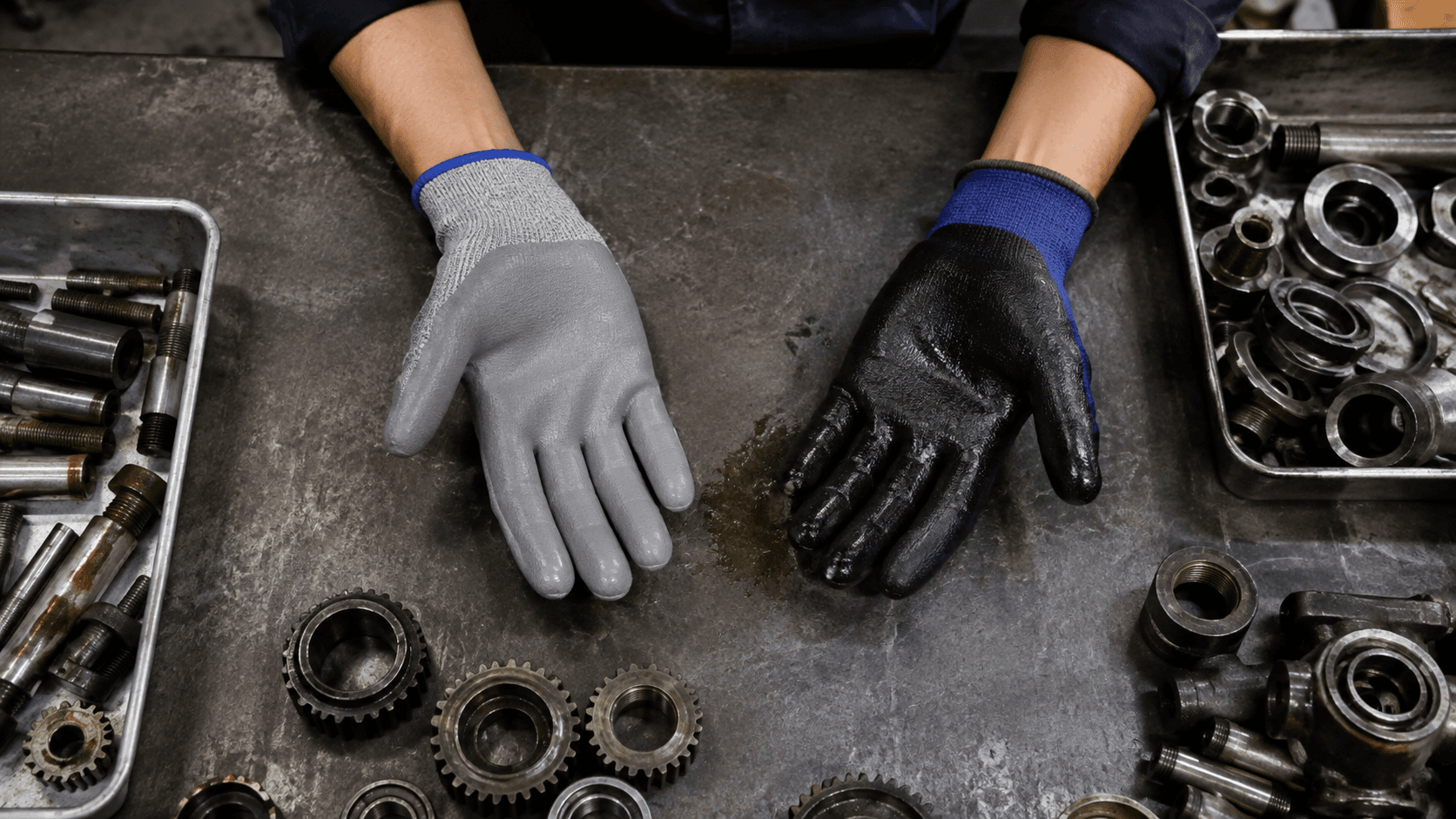
Illustrative image, not evidence of testing or a documented customer project. Procurement guidance does not replace product instructions or competent workplace assessment.
Primary topic: latex vs nitrile grip construction gloves
Introduction
Latex vs nitrile grip construction gloves is a useful comparison only when the task and surface conditions are defined. Coating chemistry is one part of the product. Texture, coating structure, coverage, liner, size and the material being handled can all affect the grip observed during use. Neither coating name alone establishes protection from wet cement, cleaning substances or other site chemicals.
Construction buyers often want one economical glove for several crews, yet carrying damp materials, assembling dry components and cleaning tools may require different decisions. A glove accepted for one handling task can be unsuitable for another. Begin with the site assessment, then compare identified models that meet the required protection and permitted-use conditions.
This article helps importers and site purchasing teams prepare samples, evaluate wet grip safely and control bulk construction. It offers an example procurement workflow, not a recommendation to expose workers to a hazardous substance during testing. Manufacturer instructions and competent site selection remain the basis for use.
Quick answer: Compare latex and nitrile models on the actual safe handling surface, not the coating label alone. Record moisture, texture, coverage, size and handling movement. Separate wet-grip observations from chemical and liquid protection claims. Verify the model’s documentation and approve the exact surface finish before buying in bulk.
Separate damp handling from chemical exposure

List the materials and substances that contact the glove. Rain on an inert training object and contact with wet cement are not equivalent exposure conditions. Identify whether moisture is water, a process liquid or contamination carrying a hazardous substance. The task description should state this distinction clearly before a supplier proposes a glove.
The Health and Safety Executive’s chemical-glove selection guidance is relevant when substances create a skin hazard. Use chemical identity and exposure information to request suitable model evidence. A good result in a water-based handling trial does not validate protection against a chemical mixture.
Record site conditions that change the decision
Describe temperature, expected wetness, abrasive contact, required dexterity and how often gloves are changed. Include whether the back of the hand or forearm can contact the material. Exposed knitted areas may be acceptable for a defined dry task but inconsistent with the coverage needed elsewhere. Avoid the broad phrase “waterproof construction glove” unless the exact product supports it.
Identify skin sensitivities through the site’s appropriate occupational process. Natural rubber latex can be relevant to allergy considerations; procurement should ask about declared materials and available alternatives without diagnosing a worker. The Health and Safety Executive’s skin guidance provides a starting reference, while individual concerns belong with appropriate professional advice.
Understand why the finish can matter as much as the material
Suppliers offer smooth, textured, crinkled, foam and other coating surfaces. These descriptions do not create a universal wet-grip ranking. Ask for close-up photographs and physical samples because catalog names may differ between factories. Identify the accepted finish on the specification rather than writing only “latex” or “nitrile.”
Two gloves with the same finish name may also differ in thickness, underlying knitting and finger shape. These differences change how the hand bends and how much contact occurs with a workpiece. Compare the complete glove, especially when a candidate requires more squeezing to feel stable.
Coverage and cuff influence use
Confirm palm-only, three-quarter or full coverage through several views. A cuff that collects liquid or interferes with a sleeve can create a different issue from the gripping surface. Ask how the manufacturer intends the glove to be worn and which exposure conditions it excludes. Do not treat the cuff as an afterthought in a wet-task RFQ.
Our palm-coated and fully coated glove guide explains coverage controls. Use it to document the accepted boundary. The coverage decision and chemistry decision should be recorded separately, so a later substitute cannot satisfy one while silently changing the other.
Compare models with a safe, repeatable task
Choose a nonhazardous trial object and a controlled handling method approved by the site team. State its dimensions, surface material and dry or damp condition. Avoid live lifting risks, sharp edges or deliberate chemical contact. The purpose is to observe handling and acceptance within safe limits, not to prove protection through exposure.
Keep size and task allocation consistent when practical. Compare candidates over the same sequence of pickup, repositioning and release. Record whether moisture spreads through the glove, whether the fingers become awkward, and whether users change their grip. Stop a trial if the task or product becomes unsuitable.
Use observations that support a decision
A form can record grip confidence, dexterity, comfort and surface condition. A defined 1–5 feedback scale may help compare responses, but it remains subjective trial information. Add written observations and reasons for rejection. Do not publish a percentage improvement from a score without a suitable method and supporting records.
For an illustrative plan, compare 2 candidates in 3 safe task conditions: dry, lightly damp and after the manufacturer-permitted cleaning step. Those numbers are example planning choices. They do not establish a recognized test method, statistical significance or approval for contaminated conditions that were not evaluated.
Verify protective claims independently of grip
Ask for reports and markings that apply to the offered model. Confirm the liner, coating and coverage described in the documentation. The Occupational Safety and Health Administration’s hand-protection rule ties selection to hazards and use conditions. A purchase team should record the required capability before deciding which acceptable model handles best.
An attractive grip result cannot compensate for missing required protection. Likewise, a relevant mechanical classification does not demonstrate resistance to a particular substance. Keep separate approval fields for task suitability, documents, wearer fit and grip observations. This prevents one favorable feature from dominating the whole selection.
Avoid “all-weather” and “all-purpose” shortcuts
Those descriptions can conceal limits in cold, prolonged wet contact, chemical handling or machinery tasks. Request defined applications and exclusions. If one crew performs materially different work, a small controlled assortment may be more appropriate than one broadly described SKU. Record when users should switch to another approved product.
For broader procurement context, consult our construction PPE checklist. Pair glove selection with the task controls and other equipment that the site uses. Compatibility with sleeves and tool handling should be reviewed during the same safe application trial.
Build a comparable commercial quotation
Describe the task, accepted texture, coverage, liner, sizes, required evidence and packing. State that substitutions require review. Ask suppliers to identify model differences openly. Comparing a thin palm-coated candidate with a different fully coated construction as if they differed only in chemistry can produce a misleading price conclusion.
| Quote field | Buyer specification | Supplier response |
|---|---|---|
| Work conditions | Defined safe handling and moisture context | Intended application and limits |
| Surface finish | Accepted sample texture | Offered model and finish |
| Coverage | Annotated front and back views | Boundary and cuff details |
| Protection evidence | Required model-specific documentation | Report and marking references |
| Packing | Pairs per inner pack and carton | Counts, size segregation and labeling |
Normalize currency, units, delivery basis and packaging before assessing a price difference. Ask whether the accepted size curve changes the minimum order. Include sample and inspection costs where relevant. There is no universal cost advantage for either coating family across all constructions and order conditions.
Send Your Requirements: Share the construction task, moisture or substance details, size mix and required documents through our inquiry form. Ask for two identified candidates suitable for review rather than a generic recommendation based on the word “wet.”
Check factory consistency before shipment
Factory testing discussions should identify the applicable method and exact product. If a buyer also agrees a grip demonstration, label it as a supplemental check and define the conditions. A video of lifting an unspecified object does not establish standardized wet-grip performance. Keep demonstrations separate from formal protective classifications.
During production follow-up, compare surface texture, coverage, pair symmetry and any important dimensions with the accepted sample. Request notification before a material or process change affects the offered product. An apparently similar finish may feel different to wearers, so preserve the physical reference as well as photographs.
Inspect more than the palm photograph
Shipment inspection should review both gloves, fingers, thumb, back and cuff. Look for bare areas, coating runs, inconsistent finish or packing that mixes sizes. Use an agreed sampling and defect classification plan. Visual inspection supports construction control; it does not establish every protective performance characteristic of the entire lot.
Document discrepancies with model, size and lot identity. When a finish differs, ask whether it represents normal agreed variation or a changed construction. Hold that decision until the relevant sample and specification can be compared. Avoid approving a replacement on a supplier’s statement that it “grips better” without the agreed evaluation.
Plan replacement and replenishment by task
Record why gloves are replaced. Loss of grip, contamination, coating damage and poor fit require different purchasing responses. Do not assume all replacement is abrasion failure. The buyer may need clearer issue rules, a different coverage pattern or separate products for cleaning and handling.
Use manufacturer instructions for cleaning and drying. Unapproved washing or exposure can alter construction and make comparisons unreliable. Store accepted spare pairs so that workers have access to the correct size and task model. A good coating choice loses its operational value when the site substitutes whatever glove remains in the stockroom.
An illustrative replenishment record might track model, task group, size, pairs issued and retirement reason each week. It should be simple enough for staff to maintain. Review changes in work volume before interpreting consumption as a product difference. Purchasing data becomes useful when it remains connected to actual use.
A release worksheet for wet-task gloves
Before authorizing a bulk order, write a short decision statement naming the accepted model and use scope. Attach the task notes, trial observations, document register and coating photographs. Name the person responsible for technical approval and the person responsible for commercial release. The responsibilities may differ even when both people attend the trial.
Record unresolved questions explicitly, such as an untested size or an excluded cleaning task. A limited approval can be useful if its limits are clear. Send the accepted specification revision to the supplier and inspection team. During repeat orders, check the model and application have not changed rather than treating the original decision as permanent.
Example: split a mixed construction requirement into two approvals
Suppose a contractor requests one glove for moving damp materials and cleaning equipment. Begin by asking which substances are involved in cleaning and whether the handling task introduces different hazards. The two activities should not be combined automatically because both are described as wet. The technical team may decide that separate models are necessary.
For the handling candidate, prepare a safe nonhazardous task comparison with identified latex and nitrile constructions. Record their different liners and finishes. If those features differ, describe the result as a comparison between complete models rather than proof that one coating chemistry always grips better. The trial should answer the actual purchasing question within its limits.
For the cleaning candidate, request the exact exposure details and relevant protective evidence through the site’s assessment. A favorable water trial from the handling comparison should not be copied into the cleaning approval. Keep the required capability and permitted use clearly separated in the product register.
If two models are accepted, use distinct stock identifiers and task issue instructions. Similar dark coatings can otherwise encourage users to take whichever pair is available. Procurement should consider labeling and availability as part of the assortment decision, particularly when crews share a stores location.
Ask the supplier to confirm the coating texture and coverage of each model in the order acknowledgment. Retain both references. During inspection, review the variants separately and confirm that packs and cartons do not mix them. A correct aggregate count does not resolve a model-allocation error.
After issue, collect grip complaints with the model and surface condition attached. A complaint from a different task may indicate an issue error or an unassessed application. The response should investigate that context before changing the accepted coating. This approach makes the comparison useful for repeat orders without overstating what a small safe trial established.
FAQ
Is latex always better for wet grip than nitrile?
No universal ranking applies to every product and surface. Texture, construction, coverage and fit all matter. Compare identified models on a safe representative task and record conditions. The result supports that purchasing decision within its limits; it should not become a general claim about every latex or nitrile glove.
Can these gloves be used for wet cement?
Do not infer suitability from the coating name or a wet-grip trial. The site must assess the substance and exposure, then select an exact model with appropriate evidence and instructions. Coverage and cuff design also matter. Treat chemical protection and handling comfort as separate approval requirements.
What does a water-based trial establish?
It can provide observations about handling under the defined safe water condition, including grip confidence, dexterity and moisture behavior. It does not establish chemical resistance, waterproof performance or standardized protection. Keep the trial method, model identities and limitations in the record so that later claims remain accurate.
What should importers inspect in the bulk lot?
Compare finish, coverage, liner, sizes, markings and pair consistency with the accepted reference. Confirm packing counts and traceability. Review required test documents separately. Use agreed sampling rather than a single display pair, and investigate changes before release if the supplied construction differs from the approved offer.
Is one glove sufficient for every construction activity?
Not necessarily. Handling, cleaning, electrical work and other tasks can involve different hazards and permitted uses. A site assessment should determine the appropriate products and any exclusions. Procurement can then maintain a manageable approved assortment with clear task labels instead of using a broad all-purpose description.
Conclusion
The latex vs nitrile grip construction gloves comparison should produce a task-specific decision. Identify the wet condition, verify protective requirements, compare safe handling and retain the accepted surface finish. Factory testing discussions and shipment inspection then support repeatability rather than replacing the original hazard assessment.
Request construction-glove samples
Review our safety glove range and request a quote. Send the material handled, contact conditions, required protection, sizes and estimated order. Ask for offered-model documentation and sample differences so that the construction team can approve the relevant use scope.
BUYER RESOURCES
Continue your PPE sourcing research.
Explore relevant PPE categories and a primary safety reference alongside this guide.Use this source alongside destination-market requirements for the exact product and application.
READY TO DISCUSS YOUR REQUIREMENT?