BUYER'S GUIDE - 12 MIN READ
Palm-Coated vs Fully Coated Work Gloves: A Buyer’s Decision Guide
Editorial information, sources and corrections
Compare palm-coated and fully coated work gloves for grip, coverage, comfort and inspection. Build a task-specific bulk purchase specification.
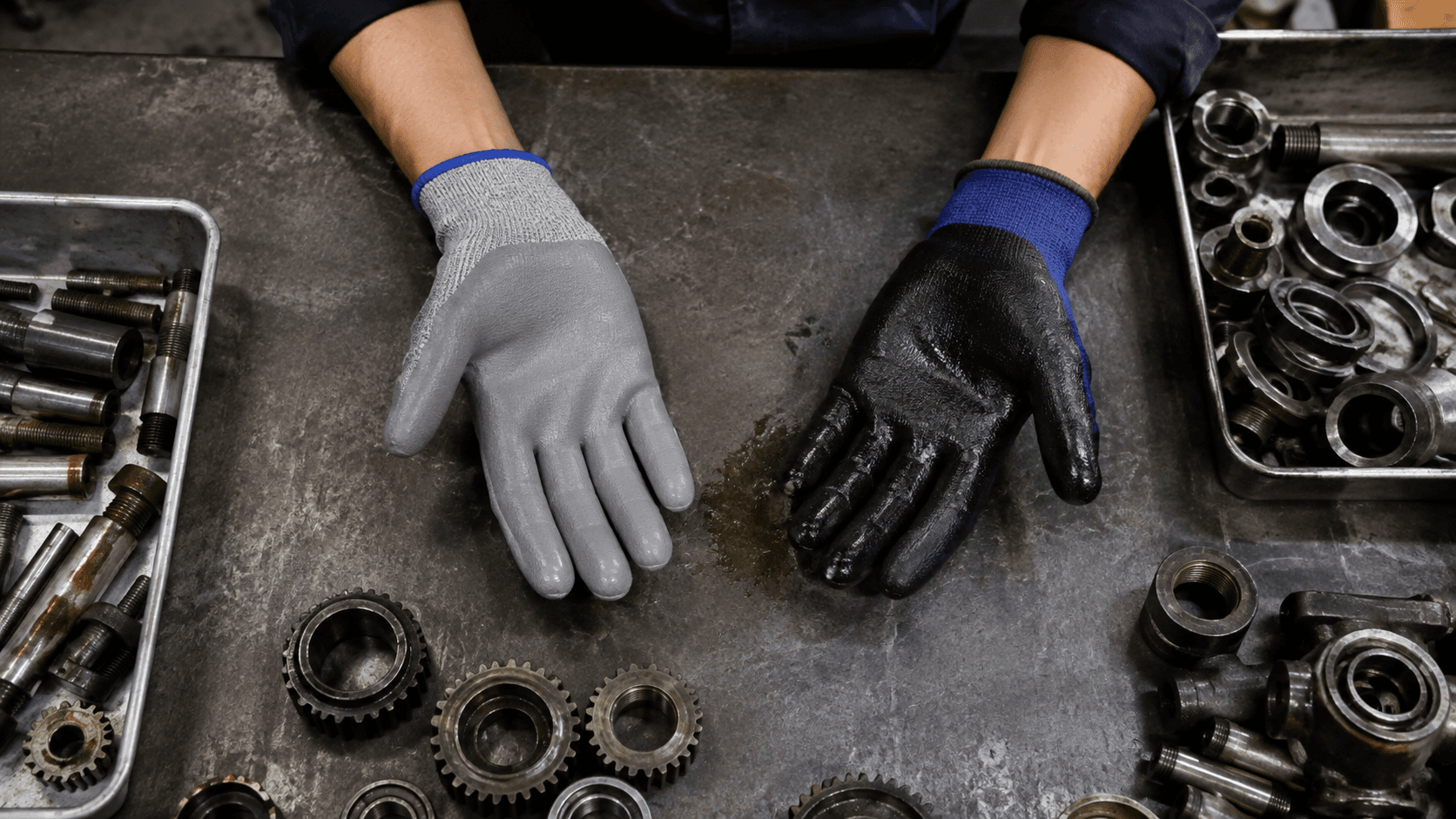
Illustrative image, not evidence of testing or a documented customer project. Procurement guidance does not replace product instructions or competent workplace assessment.
Primary topic: palm-coated vs fully coated work gloves
Introduction
Palm-coated vs fully coated work gloves is a coverage decision before it is a price decision. A palm coating concentrates a surface layer on the gripping side while leaving more of the knitted back exposed. Full coating extends coverage around the hand, but the exact boundary, coating layers and cuff treatment vary by model. Neither construction automatically establishes chemical, cut, liquid or thermal protection.
For distributors and industrial purchasing teams, the useful question is where contact occurs during the task. Workers handling dry cartons may value an open back and flexible fingers. A different operation may expose the back of the hand to dirty or damp surfaces and justify greater coverage. The same coating name can describe materially different products, so compare an identified sample and its evidence rather than a catalog photograph.
This guide explains how to turn coverage into an RFQ, evaluate representative use, and inspect a bulk lot. The examples are proposed buyer workflows, not claims about a documented PPEgen customer project. Start with the hazard assessment and the exact model documentation; then decide which construction belongs in the approved range.
Quick answer: Choose coating coverage by the surfaces that contact the hand, the required grip, environmental conditions and wearer acceptance. Compare samples with equivalent protection requirements. Confirm the coating boundary, cuff, layer construction and cleaning instructions in writing. A fully coated knitted glove is not necessarily a liquid-tight or chemical-protective glove.
What does glove coating coverage actually describe?

Coverage is the geographical extent of a coating, not a complete specification of its performance. Palm-dipped products commonly cover the palm and gripping surfaces of the fingers, with an exposed knitted area on the back. Three-quarter coverage, full dipping, double dipping and additional palm layers introduce other configurations. Suppliers may use these names inconsistently.
Ask for front, back, side and cuff photographs of every offered model. Mark the accepted boundary on a drawing or reference sample. A photograph taken from the palm can make partial and full coverage appear identical, particularly with dark yarn and dark coating. An annotated back view prevents that confusion during quotation and receiving.
Separate coverage from coating chemistry
Nitrile, latex and polyurethane identify broad material families. They do not specify surface texture, formulation, layer thickness, underlying liner, processing or test performance. A smooth nitrile layer and a textured nitrile surface can behave differently during handling. Open pores, foam structures and exposed knitting also influence the way contamination travels through a glove.
Specify the combination: liner identity, coating material, coverage, finish, cuff and documented protection requirements. Our coated glove comparison guide gives broader material context; this article focuses on the coverage decision. Avoid approving an unspecified “equivalent full-dip glove” when the offer omits the features that made the sample acceptable.
Match coverage to the contact pattern
Observe how objects are picked up, carried, repositioned and released. A grip that appears palm-only in a demonstration can include finger backs when the wearer reaches inside a bin. Describe the workpiece, surface condition, hand posture and contact locations. Distinguish nuisance dirt from a hazardous substance requiring documented protective capability.
For example, a proposed warehouse trial could separate dry carton handling from cleaning tasks. The warehouse sample might prioritize grip and ventilation. Cleaning would require a separate assessment of substances, exposure and suitable glove documentation. Combining both tasks under “general purpose” can conceal a significant mismatch.
The Occupational Safety and Health Administration’s hand-protection rule ties glove selection to task conditions, exposure duration and identified hazards. A buyer’s coating preference should sit within that assessment. Do not let a broader coverage photograph substitute for the performance evidence that the workplace actually needs.
Record what should never be inferred
Full coverage does not mean resistance to every liquid, and dry-grip suitability does not establish safe performance with a particular solvent. Cut resistance belongs to the tested construction and method, not to the percentage of dipped area alone. Electrical, heat and chemical uses require their own applicable evidence and competent selection.
Likewise, a glove may introduce an entanglement concern around moving equipment. The machine task and site instructions determine whether gloves are appropriate at all. Coverage comparisons are only relevant after the task permits glove use. Keep that exclusion visible in the purchasing brief rather than leaving it to a wearer to discover.
Compare breathability, flexibility and contamination control
An exposed knitted back may improve airflow and evaporation relative to an otherwise comparable fully coated glove. The magnitude is model-dependent, and subjective comfort also depends on temperature, task intensity, fit and wear duration. Treat “breathable” as a claim to investigate, not a universal ranking between two product families.
Greater coverage can reduce direct soiling of exposed yarn in certain applications. It may also change hand heat and moisture management. A wearer who repeatedly removes an uncomfortable glove creates a different operational problem from a glove that stays on but becomes dirty quickly. Record both behaviors in the trial.
Use a controlled comparison
Where practical, select comparable liner constructions, sizes and required protection levels. Trial each sample during the same safe task sequence, with similar surface conditions and work duration. Record sweating, flexibility, pressure points, grip confidence and unexpected contamination. Do not instruct workers to test protection by deliberately contacting a hazard.
A simple scoring sheet can use a 1–5 scale for comfort and dexterity, provided the scale is defined before testing. These numbers are purchasing observations rather than safety certifications. Include a separate pass-or-hold field for model documentation and hazard suitability; a comfortable sample cannot compensate for a missing required protective capability.
Build a quotation that suppliers can reproduce
State the accepted coverage boundary in the RFQ and attach a reference image. Include whether the fingertips, thumb back and wrist area must be coated. Define the permitted uncoated cuff and any second palm layer. Request the supplier’s offered model code and explicit exceptions rather than assuming it interprets the drawing as intended.
| RFQ field | Evidence to request | Purchasing purpose |
|---|---|---|
| Coating boundary | Annotated images and retained sample | Prevent partial-coverage substitution |
| Liner and size | Construction sheet and size chart | Keep fit and flexibility comparable |
| Surface finish | Close-up sample photographs | Identify the accepted texture |
| Required protection | Exact-model reports and markings | Connect claims to the supplied product |
| Care and limits | Manufacturer instructions | Plan use and replacement correctly |
Clarify units at the same time. A price per pair cannot be compared with a price per individual glove without conversion. Ask whether the quotation includes each size, private-label marking, inner packs and export cartons. If the full-coverage option has a different minimum order, compare the inventory consequence as well as the unit price.
Send Your Requirements: Share the workpiece, contact surfaces, destination market, estimated quantity and required documentation through our PPE inquiry page. Include front and back images of an acceptable glove if available. That information makes the coverage comparison easier to quote and less dependent on product nicknames.
Approve samples through a written decision
Begin sample approval with identity. Assign each candidate a temporary reference, photograph its markings, and record the supplier model and size. An unlabeled sample bag becomes difficult to reconstruct when several similar coatings arrive. Keep the evaluation sheet linked to the exact sample rather than to an email thread titled “gloves.”
Next, separate appearance observations from functional trials. Appearance checks identify coverage consistency, coating runs, bare spots, finish and cuff workmanship. Functional evaluation examines safe handling, flexion, fit and user acceptance in the intended application. Model-specific factory testing supports relevant performance claims, while the buyer trial addresses application suitability within its scope.
Example of a coverage approval record
An illustrative record could list 3 candidate models, 2 representative sizes and 2 approved handling tasks. These are example planning quantities, not a prescribed test sample or acceptance standard. Document why a candidate was selected, the conditions excluded from approval, and any outstanding supplier clarification.
Attach the accepted back-of-hand photograph to the purchase specification. Record whether minor coverage variation is permitted and how it will be assessed. If the boundary is commercially important, define an appropriate measurement method and tolerance with the supplier. Do not invent a millimeter tolerance after production has already finished.
Inspect coating coverage before shipment release
Shipment inspection should compare sampled pairs with the signed specification and retained reference. Check both hands, multiple sizes and representative cartons according to the agreed sampling plan. Inspectors should unfold fingers and cuffs so that the back and sides are visible. A palm-only photograph does not document full coverage.
Look for unexpected boundary differences between left and right gloves, exposed patches where coverage was required, runs that restrict movement, and a finish inconsistent with the approved sample. Categorize observations using the agreed defect definitions. A visual check can identify construction discrepancies, but it does not replace required laboratory performance testing.
Control substitutions and corrective action
If the supplier changes a coating process, liner source or coverage pattern, require a documented review before release. A visually similar substitute may alter fit, handling or the applicability of supporting reports. Record the affected model, sizes, lots and sample references. Avoid giving approval to an undefined “improved coating.”
When an issue appears, ask for photographs showing the complete glove, the specific discrepancy and lot identification. Decide whether further sampling, containment or a new sample approval is needed. Our pre-shipment quality-control guide provides a broader release framework for that discussion.
Compare cost without buying unnecessary coverage
Additional coating can change material use, processing and handling, but there is no universal price premium that applies to all suppliers. Compare like-for-like quotations and ask which specification differences drive the offered price. A cheaper partial coating is poor value when the task requires the accepted broader construction; the reverse is also true when extra coverage adds no useful benefit.
Estimate cost using usable pairs issued to the intended task, not only the purchasing total. Include damaged packs, mis-sized stock, trial rejects and replacement behavior. For an illustrative order, dividing a total landed cost of USD 600 by 300 accepted pairs gives USD 2 per accepted pair. The figures are arithmetic examples, not PPEgen prices or a market benchmark.
Care assumptions also matter. Do not include multiple laundering cycles in a cost model unless the manufacturer permits that process and performance after cleaning has an appropriate basis. The Health and Safety Executive’s PPE guidance is a useful program-level reference alongside the actual glove instructions.
Prepare a repeat-order checklist
Before reordering, check whether the task, surface condition, wearer population or destination requirement has changed. Confirm that the supplier is offering the same accepted construction and coverage. Compare current photographs with the retained reference, not with a generic catalog image. Keep size demand and replacement observations in the review.
- Record supplier model, buyer SKU and approved sample revision.
- Confirm palm, finger, thumb-back and wrist coverage individually.
- Match liner, coating finish, required evidence and care instructions.
- Review wearer feedback without converting comfort scores into safety ratings.
- Require approval for substitutions and document shipment inspection findings.
If several branches buy the same glove, distribute the accepted image set and application limits to all locations. Local names such as “black nitrile glove” are too broad to maintain consistency. A centralized purchasing description helps prevent a substitute from entering through a branch order that lacks the original technical brief.
Example: compare two offers without losing the coverage requirement
Consider a buyer reviewing a palm-coated sample already accepted for dry handling and a fully coated candidate offered for a different task. The buyer should first ask whether both candidates satisfy the relevant technical requirement. If they do not, the price table should show that they serve different scopes rather than rank them as interchangeable options.
Prepare a comparison sheet with the coating boundary images beside the model codes. Add the intended task, permitted care and relevant documents. Leave a separate field for wearer feedback. This prevents an attractive comfort result from obscuring an unresolved capability or an unexpected construction change.
Suppose the supplier quotes the full-coverage candidate with a different liner and a thicker palm. The buyer cannot attribute all differences in handling to coverage alone. Request a clearer comparison where feasible, or describe the offer as a complete alternative construction. That distinction makes both the purchasing decision and subsequent product description more accurate.
After selecting a model, send the accepted image sheet to the factory and inspector. Ask the supplier to confirm the same construction in its order acknowledgment. When shipment photographs arrive, compare the back and sides as well as the palm. If the images omit the critical boundary, request the relevant views rather than approving from incomplete evidence.
On the next order, review whether the task remains the same and whether any user complaints concern fit, coating wear or contamination. Keep those reasons separate. A coverage change should answer a specific application need, not become a routine response to every glove complaint. The retained decision sheet makes this review possible without repeating the entire selection process from memory.
FAQ
Are fully coated gloves always better than palm-coated gloves?
No. Greater coverage may be useful when the task involves contact outside the gripping surface, but fit, ventilation and handling still matter. Choose the construction against the actual application and required protection. Compare identified samples rather than assuming that more coating means a higher overall protection level.
Can a fully coated knitted glove be described as waterproof?
Only use that claim when the exact construction and supporting evidence justify it. Coverage alone does not establish liquid-tight performance. Exposed cuffs, porous layers and construction details can matter. Request the manufacturer’s stated use and limitations, and do not extend the claim to chemical protection without separate evidence.
What is the most important photograph in sample approval?
Use several views, especially the back and sides, because a palm photograph may conceal differences in coverage. Include the model marking and size. Link the photographs to the retained sample and specification revision so that a shipment inspector can reproduce the intended comparison before export release.
How many pairs should be included in a wearer trial?
Choose a trial plan that represents relevant sizes, tasks and environmental conditions. There is no universal pair count that makes every workplace evaluation valid. Keep the trial separate from statistical shipment sampling and laboratory testing. Record the limitations when only a small purchasing trial is feasible.
Should the same glove cover handling and cleaning?
Assess the tasks separately. A glove accepted for dry materials handling may lack the evidence needed for cleaning chemicals or prolonged wet exposure. Use the site’s hazard assessment and exact-model instructions to decide whether one product is suitable for both, or whether separate approved models are required.
Conclusion
The palm-coated vs fully coated work gloves decision becomes practical when coverage is specified as clearly as the material and size. Map contact locations, select the required protective capability, compare safe wearer trials and retain an approved reference. Follow that reference through factory testing discussions, shipment inspection and repeat orders.
Get a coated-glove quotation
Browse our safety glove category and ask PPEgen for a quote. Send the application, preferred coverage images, target market, quantity and size mix. A useful response should identify the offered model, its exceptions and the documentation available for review before you approve bulk supply.
BUYER RESOURCES
Continue your PPE sourcing research.
Explore relevant PPE categories and a primary safety reference alongside this guide.Use this source alongside destination-market requirements for the exact product and application.
READY TO DISCUSS YOUR REQUIREMENT?