BUYER'S GUIDE - 10 MIN READ
Metal vs Textile Puncture-Resistant Midsoles: A Buyer Comparison
Editorial information, sources and corrections
Compare metallic and nonmetallic safety-footwear midsoles without assuming either is universally puncture-proof. Includes test, fit and RFQ checks.
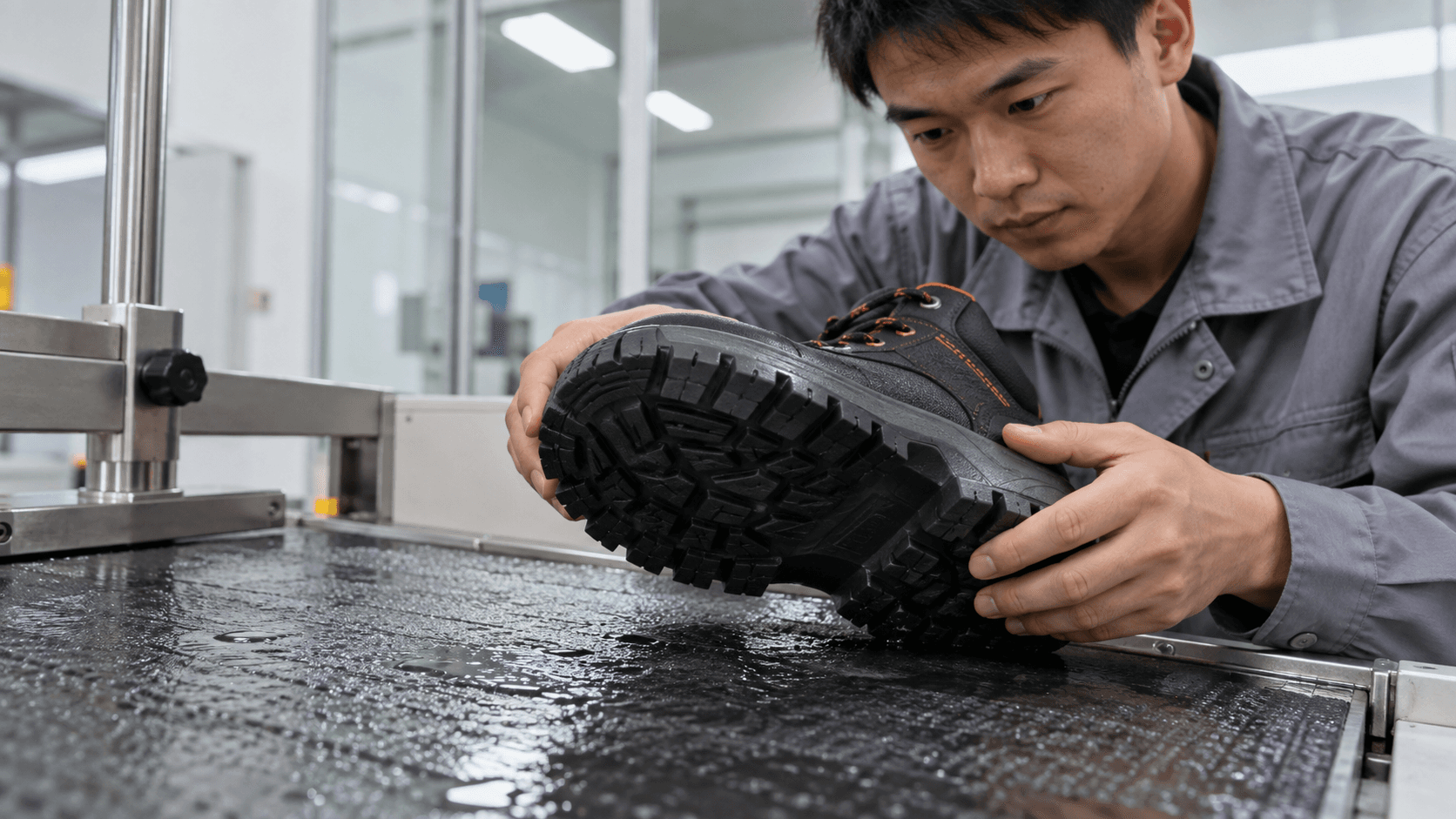
Illustrative image, not evidence of testing or a documented customer project. Procurement guidance does not replace product instructions or competent workplace assessment.
Primary topic: metal vs textile puncture resistant midsole
Introduction
A puncture-resistant midsole is a response to sharp objects underfoot—not a generic measure of how "strong" a safety boot is. Metallic plates and nonmetallic or textile layers can differ in flexibility, coverage, weight and test performance. Neither material name establishes that a particular boot protects against every nail, shard or thin point.
This guide is for importers comparing footwear offers for construction, waste handling, warehousing or maintenance. It shows how to define the underfoot hazard, read the exact-model claim and run a safe fit trial. It does not promise immunity from puncture or equate results from unlike standards and probes.
Quick answer: Specify the relevant underfoot sharp-object hazard and destination standard, then request the puncture-test claim for the finished boot. Compare metallic and textile designs by tested method, protected area, durability, flexibility and fit. A "steel plate" description or "metal-free" label alone is not proof of suitable puncture protection.
Define the point and path of exposure
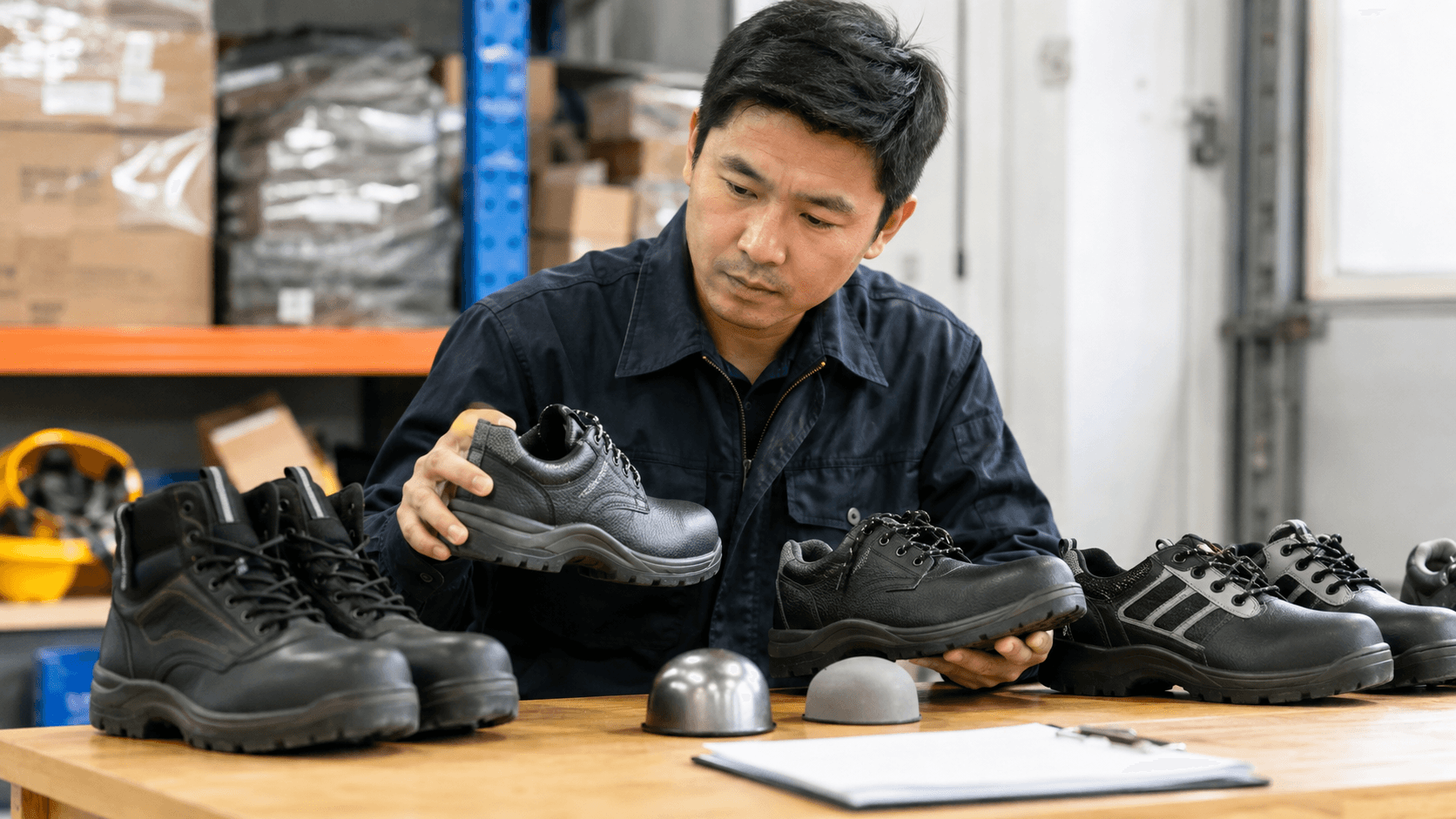
Ask what sharp objects lie on the ground, their approximate geometry, whether they may be obscured by debris, and how workers walk or kneel. The OSHA foot-protection rule addresses hazards from objects piercing the sole. The employer should reduce debris and unsafe work conditions before relying solely on footwear.
A broad nail, thin tack, glass shard or jagged sheet edge does not interact with a sole identically. Test methods specify an object and conditions; a claim under one method should not be extended to every point shape. Discuss unusual hazards with the safety team and ask the supplier which limitations apply.
Look at the whole sole assembly
The midsole is only one layer. Outsole tread, wear, flex points and insert placement influence practical use. A puncture layer that stops short of a region where sharp objects can contact the foot may leave a gap. Request construction drawings or section information for the offered model, while understanding that commercial drawings do not replace performance tests.
Compare materials without stereotypes
Metallic and textile/nonmetallic inserts can each be engineered differently. Metal may provide a known physical barrier in a particular construction; textile systems may offer flexibility or lighter feel. But coverage and test result depend on the complete boot and applicable standard. Claims such as "nonmetallic means no airport screening" or "metal means 100% puncture proof" are not valid sourcing criteria.
| Comparison | Metallic insert | Nonmetallic/textile insert | Buyer action |
|---|---|---|---|
| Material identity | May include metal | May use layered textile/polymer | Obtain exact construction claim |
| Flexibility | Varies by design | Varies by design | Safe wearer trial |
| Coverage | Varies by cut and placement | Varies by layer shape | Request model information |
| Test result | Must be exact-model | Must be exact-model | Compare same method and edition |
| Other foot hazards | Separate toe/slip/chemical claims | Same separation | Build task-based specification |
OSHA's shipyard foot guidance illustrates the need to consider puncture, impact and other hazards separately. For a different jurisdiction, review the applicable standard and local legal duties rather than importing a US label uncritically.
Demand precise marking and test evidence
Ask for the finished boot model, size range, protective standard and edition, puncture marking, test method/probe where relevant, instructions and any limitations. Verify whether the claim applies across sizes and outsole variants. A test certificate for a boot with one sole construction cannot be assumed to cover a visually similar boot with another insert.
If two products use different test methods or probe sizes, do not rank them by a single number stripped from its method. Ask a qualified reviewer to interpret the evidence in the destination context. Marketing terms like "penetration-proof" should be challenged; puncture-resistant footwear has test-defined performance, not absolute immunity.
The HSE PPE-selection guidance supports suitability and compatibility checks. That includes adequate fit and the other hazards around the underfoot task.
Mid-article CTA — Send Your Requirements: Tell PPEgen the work surface, sharp-object hazard, required destination standard, toe/slip needs and size mix. We can prepare a comparison of exact boot models and document gaps. Contact us.
Trial mobility and real-world wear safely
Do not test puncture resistance by asking a worker to step on a nail. Use laboratory evidence for protective claims, and use a safe wearer trial for comfort, bending, stair use, grip and fatigue. Let representative users wear the approved model with normal socks and other PPE. Record hot spots, flex discomfort, heel movement and whether laces or closures maintain fit.
Review outsole wear and storage instructions. A heavily worn boot may no longer perform as expected even if the midsole is intact. Follow the maker's inspection and replacement guidance. A puncture event or damaged sole should trigger the site's withdrawal process rather than a cosmetic patch.
An illustrative decision: a contractor offers a lightweight "metal-free" shoe for a debris-heavy site. Procurement asks for the exact puncture marking and test report, trials mobility with workers and confirms that the site also needs toe and slip protection. If the supplier can document only the absence of metal, the offer is incomplete. This is a hypothetical workflow, not a PPEgen test result.
Control the purchased and shipped model
The PO should name the approved boot, insert construction where relevant, size distribution, outsole, protective markings, packaging and required documents. At pre-shipment inspection, confirm representative units have the correct labels, sole design and size; look for visible defects, uneven attachment or packaging damage. Keep sample and lot photos. A substitution of sole or insert material requires renewed review even if the retail model name is unchanged.
Use the safety footwear category for product discovery and the metatarsal versus safety-toe guide for top-of-foot impact needs. These are separate from underfoot puncture protection.
How test methods change a buyer's interpretation
Puncture tests use specified probes, forces and procedures. Results make sense only with the method and standard edition attached. A supplier may show a familiar protective symbol while an importer needs to know which insert, sole and version were actually tested. Ask for the report scope and compare it to the physical sample. If one boot uses a textile layer and another a metal plate, avoid declaring one safer from the material label or from numbers measured under different methods.
Ask whether the protective layer extends across the whole area of the sole that the task exposes. A drawing may show a margin at the edge or different coverage near the heel and forefoot. The buyer should flag these questions for the manufacturer and the qualified site reviewer. Do not turn a drawing into an unverified claim that all underfoot impacts are protected. Movement, point geometry and wear remain relevant limitations.
Why a safe physical trial still matters
Workers can compare flexibility, heel hold, toe room and grip without stepping onto sharp objects. Set up a representative walking route free of puncture hazards: stairs, smooth floor, a controlled uneven surface and bending motions if relevant. Record sizes, sock type and comments. Ask whether one design causes the wearer to avoid the approved shoe for certain tasks. A technically acceptable model that is regularly left unworn is not a good operational solution.
The trial should not be used to justify a lower technical claim because the shoe feels lighter. Separately confirm every required foot hazard: impact, metatarsal, slip, electrical or chemical. A textile layer may be comfortable yet not meet the site's specified puncture requirement; a metal insert may meet a test but create fit issues for some users. Treat these as distinct findings.
Inspect changes in the full sole assembly
The outsole, puncture insert, footbed and upper form a finished product. A supplier change to one layer may alter fit or protective evidence. Put construction or revision identifiers in the approval file. If the manufacturer will not disclose proprietary layer details, request enough exact-model test and change-control information for the buyer's reviewer to make a decision. A confidentiality agreement may be appropriate for sensitive drawings, but a vague statement that "the quality is the same" is not evidence.
At incoming inspection, compare outsole pattern, marking, size and model code with the approved sample. The insert may be hidden, so documentary traceability and supplier quality controls matter. Use a defined sampling plan and ask the supplier for production records when a construction change is suspected. Do not cut open random shipped boots and then treat the altered units as saleable product. A destructive sample may be appropriate only under an agreed inspection protocol.
Replacement and incident records
Record underfoot puncture events, damaged soles and withdrawal reasons. A sole pierced by a sharp object should be assessed under the manufacturer's instructions and site policy, not casually sealed and returned to use. The event may reveal that housekeeping or waste segregation is inadequate. Footwear can be a residual control but should not normalize walking through sharp debris.
Use actual replacement history to compare bids. Lower upfront price may be offset by poor fit, premature outsole wear or unavailable sizes. Conversely, an expensive insert material does not guarantee longer service life in a specific worksite. Procurement can collect consistent observations by model, task and lot, while the safety team retains decisions about acceptable protection.
FAQ
Is a steel midsole always safer than a textile one?
No. Judge the exact boot against the relevant hazard and test evidence. Material alone does not establish coverage or performance for every sharp point.
Does "metal-free" mean the boot is puncture resistant?
No. It describes a material characteristic. Ask for the applicable puncture claim and finished-product evidence.
Can a puncture-resistant boot replace good housekeeping?
No. Remove sharp debris and use worksite controls. Footwear addresses residual exposure within its tested limits.
Does a safety toe include puncture protection?
Not automatically. Toe impact and underfoot puncture are separate claims and should both appear in the specification if needed.
How should I compare different countries' markings?
Review the destination's applicable standard and test method with a competent specialist. Avoid a direct numerical conversion where probes, procedures or classifications differ.
Should a buyer ask for a puncture demonstration video?
A video can illustrate construction but is not a standardized performance test. The object, force and shoe condition in an informal clip may not match the workplace or the applicable method. Use exact-model test evidence and instructions for the protective claim. If a buyer receives a dramatic demonstration, ask what it actually proves and what it leaves untested. A safe fit trial and a traceable laboratory report answer different questions and should both be kept in the product file.
How should a changed outsole be handled?
Treat it as a potential change to the approved finished boot. Request the manufacturer's explanation and updated documentation, then have the site reviewer decide whether the puncture, slip and other foot-protection claims remain suitable. A distributor should not quietly accept a new sole because the upper and logo are unchanged. Update the reference sample and receiving checklist only after technical approval.
For repeat buyers, inspect customer complaints by location and sharp-object type. A reported penetration from a thin point does not automatically prove every product in a batch failed its laboratory classification; it does signal a need to investigate the incident, equipment condition and test scope. Retain the affected boot and lot details where site procedures allow. Avoid a simplistic marketing response such as "upgrade to metal" until the hazard, method and product evidence have been reviewed.
If the buyer requires metal-free footwear for a specific process, define what "metal-free" means in the specification. A nonmetallic puncture layer may coexist with a metal eyelet or other component. An airport or scanner claim also depends on the facility and detection equipment. Ask for exact construction details and avoid promising that any shoe will never trigger a security system.
How can importers avoid misleading material claims?
Use descriptions such as "metallic puncture-resistant insert" or "nonmetallic puncture-resistant layer" only when the offered construction supports them. Avoid "puncture proof," "needle proof" or a claim that one material always outperforms the other. A customer may need an explanation of which standard and method produced the reported result, what other foot hazards are covered and what the limit is. Keep the technical file, label and online listing aligned. If a distributor changes a model from a metal plate to a textile insert, update the description and obtain approval rather than retaining the previous evidence and imagery.
Conclusion
Metal and textile puncture layers are design choices, not guarantees. A sound purchase starts with the underfoot hazard, verifies exact-model test claims and fit, and preserves the approved sole construction through shipment and service. Keep toe, metatarsal and slip needs separately visible in the RFQ.
Final CTA — Get a Quote: Send your underfoot hazard description, destination market and size/quantity needs to info@ppegen.com. PPEgen can prepare model-specific options and an evidence request list.
BUYER RESOURCES
Continue your PPE sourcing research.
Explore relevant PPE categories and a primary safety reference alongside this guide.Use this source alongside destination-market requirements for the exact product and application.
READY TO DISCUSS YOUR REQUIREMENT?