BUYER'S GUIDE - 5 MIN READ
N95 vs FFP2 vs KN95: A Practical B2B Buying Guide for Respiratory Protection
Editorial information, sources and corrections
Compare N95, FFP2 and KN95 respirators for industrial procurement, including approval checks, fit, documentation, packing and shipment inspection.
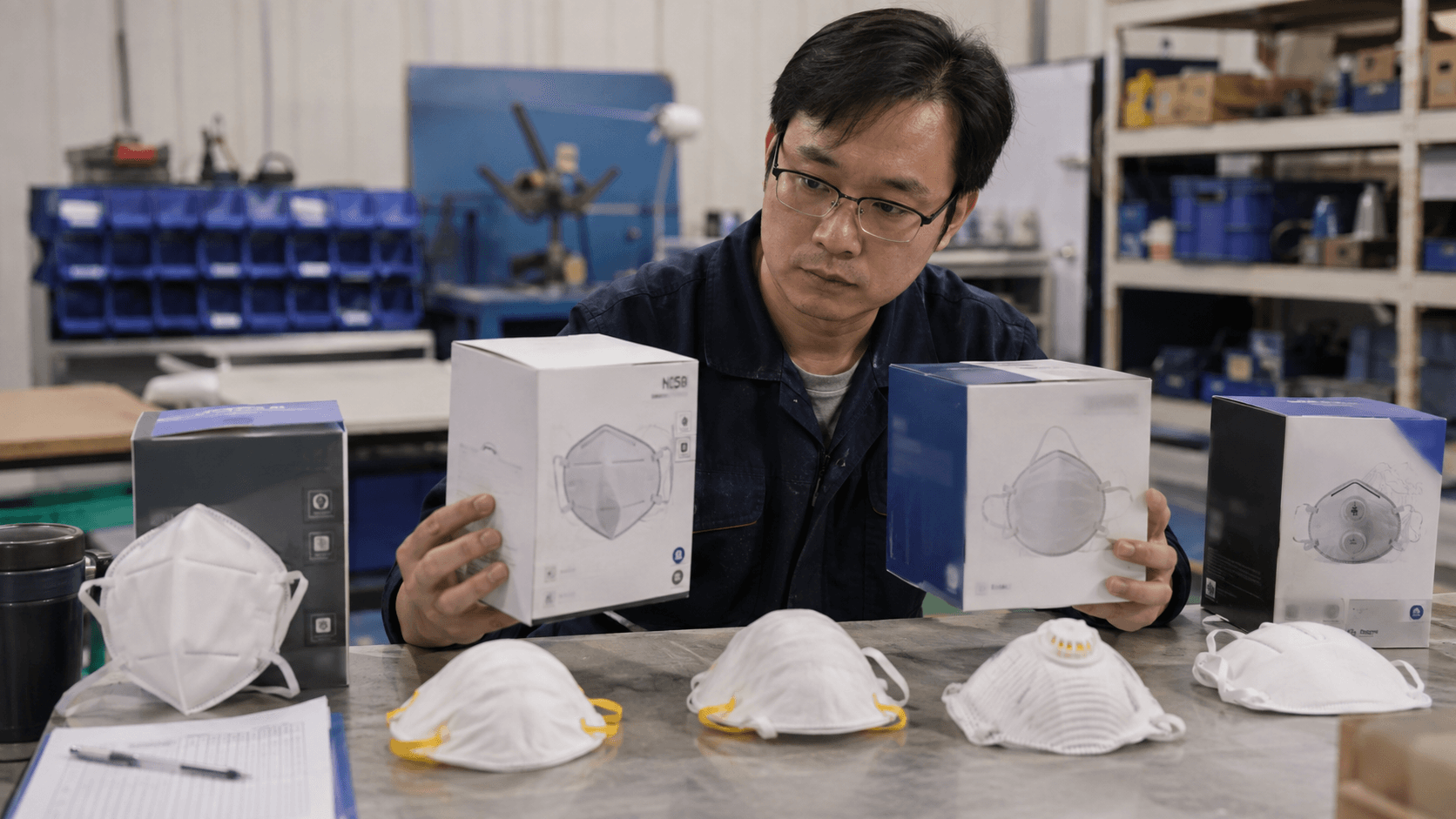
Primary topic: N95 vs FFP2 vs KN95
Introduction
N95, FFP2 and KN95 are often grouped together in purchase requests because they are filtering facepiece respirators intended for particulate hazards. That does not make them interchangeable purchasing labels. Their regulatory routes, marking requirements, approval systems and customer-market expectations differ. A responsible buyer starts with the workplace hazard and destination market, then confirms the exact product documentation.
Quick answer: Buy the respirator required by the job and market—not the label that happens to be cheapest. Confirm the applicable standard, product model, approval or conformity documentation, fit, packaging traceability and inspection plan before production.
What do N95, FFP2 and KN95 mean?

N95 is a United States NIOSH respirator class. NIOSH explains that an approved N95 must have the required approval marking and a TC approval number that can be checked in the Certified Equipment List. FFP2 is a European class used under the relevant EN 149 framework. KN95 is a Chinese classification commonly associated with GB 2626. Each term describes a defined conformity route; it is not a generic promise that every mask gives the same workplace protection.
| Purchase question | Why it matters |
|---|---|
| Where will the product be sold and used? | Market rules and customer specifications can differ. |
| What is the airborne hazard? | Filtering facepieces are for particles, not gases or vapours. |
| Does the worker need an occupational respirator programme? | Selection, fit, training and maintenance are part of protection. |
| Is a specific approval required? | A test report alone may not support a regulated approval claim. |
NIOSH states that filtering facepiece respirators protect against particles such as dust, mist and fumes, but not gases or vapours, and require fit testing. Read its filtering facepiece guidance before treating a disposable mask as a complete respiratory solution.
Choose by application, not by a conversion chart
Conversion charts can be helpful for initial sourcing, but they should not be used to make a compliance claim. A contractor may request FFP2 because the project is in Europe; a US industrial buyer may require a specific NIOSH-approved N95; a distributor may need a KN95 configuration for a market where that specification is accepted. The procurement file should state the requirement in words: target market, standard edition where known, model, valve preference, packaging language, and evidence required.
Match the mask to the work environment
For dust-generating tasks, first review engineering controls and task exposure. A disposable respirator is only one layer of protection. If oil aerosols, solvent vapours, oxygen-deficient spaces, high contaminant concentrations or unknown atmospheric conditions are involved, a filtering facepiece may be unsuitable. The employer’s competent safety professional should select the respiratory protection programme and equipment.
Fit is a product requirement
Two masks with similar laboratory performance can seal differently on a worker’s face. During sample approval, use the intended donning method, nose bridge, head straps and facepiece shape. Record feedback from representative users; avoid approving only from a flat product photo. Facial hair, incorrect positioning and damaged straps can compromise the seal even where the filter media is correct.
A B2B checklist for documentation and factory testing
Ask suppliers to identify the document, model and issuing body—not simply attach a folder of unrelated certificates. For each SKU, retain a controlled file containing:
- Approved technical drawing, model number and bill-of-material description.
- Applicable test reports or approval references for that exact configuration.
- Label and packaging artwork showing required marks, lot coding and warnings.
- Production quality-control record for straps, nose clips, valve components if used, and workmanship.
- Shipment inspection report, carton count and shipping marks.
At factory testing, distinguish a type test from routine production checks. The former supports a documented performance claim under a method; the latter checks whether the manufactured order follows the approved construction. A change to media, strap attachment, nose foam or facepiece design should trigger a controlled review—not a verbal assurance of “same quality.”
Compare quotes on the same basis
The lowest unit price is rarely comparable unless the product configuration is identical. Request a quote table that covers the model, standard or approval route, headband or ear-loop design, valve status, packing, country-of-origin details, artwork, MOQ and lead time. For private label orders, confirm which entity is permitted to make any regulated claim on the packaging.
| Quote line | Ask the supplier to state |
|---|---|
| Product identity | Exact model, size or universal-fit statement, colour and components |
| Compliance evidence | Standard, report reference, approval holder where relevant, and limitations |
| Packing | Units per box, boxes per carton, dimensions, gross weight and lot traceability |
| Delivery | Sample approval date, production lead time, inspection window and Incoterm |
For general supplier due diligence, see our PPE supplier selection guide and use the same approved-sample discipline described in our pre-shipment inspection checklist.
FAQ
Is an N95 the same as an FFP2 or KN95?
They are distinct classifications under different systems. Their stated filtration performance may be discussed together, but buyers should not treat the terms as automatic legal or functional equivalents. Select according to the applicable requirement and verify the specific product evidence.
How can a buyer check a NIOSH N95 claim?
Check the model’s required marking and TC approval number against the NIOSH Certified Equipment List. A seller’s certificate image is not a substitute for verifying the approved product identity.
Can a filtering facepiece protect against solvent vapour?
No. NIOSH describes filtering facepieces as particle protection. A respiratory hazard assessment is needed for gases and vapours.
Conclusion
The useful comparison is not “which label is better?” but “which documented product meets this job, market and user requirement?” Clear specifications, sample trials, traceable packaging and shipment inspection reduce avoidable surprises after import.
CTA: Send Your Respirator Requirement
Send your application, destination market, required standard, quantity, packaging artwork and delivery target. PPEgen can help turn those customer requirements into a quote-ready respirator specification and inspection checklist.
BUYER RESOURCES
Continue your PPE sourcing research.
Explore relevant PPE categories and a primary safety reference alongside this guide.Use this source alongside destination-market requirements for the exact product and application.
READY TO DISCUSS YOUR REQUIREMENT?