BUYER'S GUIDE - 12 MIN READ
What Hazards Do Safety Gloves Protect Against, and What Are Their Limitations?
Editorial information, sources and corrections
Understand what safety gloves can and cannot protect against, including cuts, punctures, chemicals and heat, before approving a task or bulk purchase.
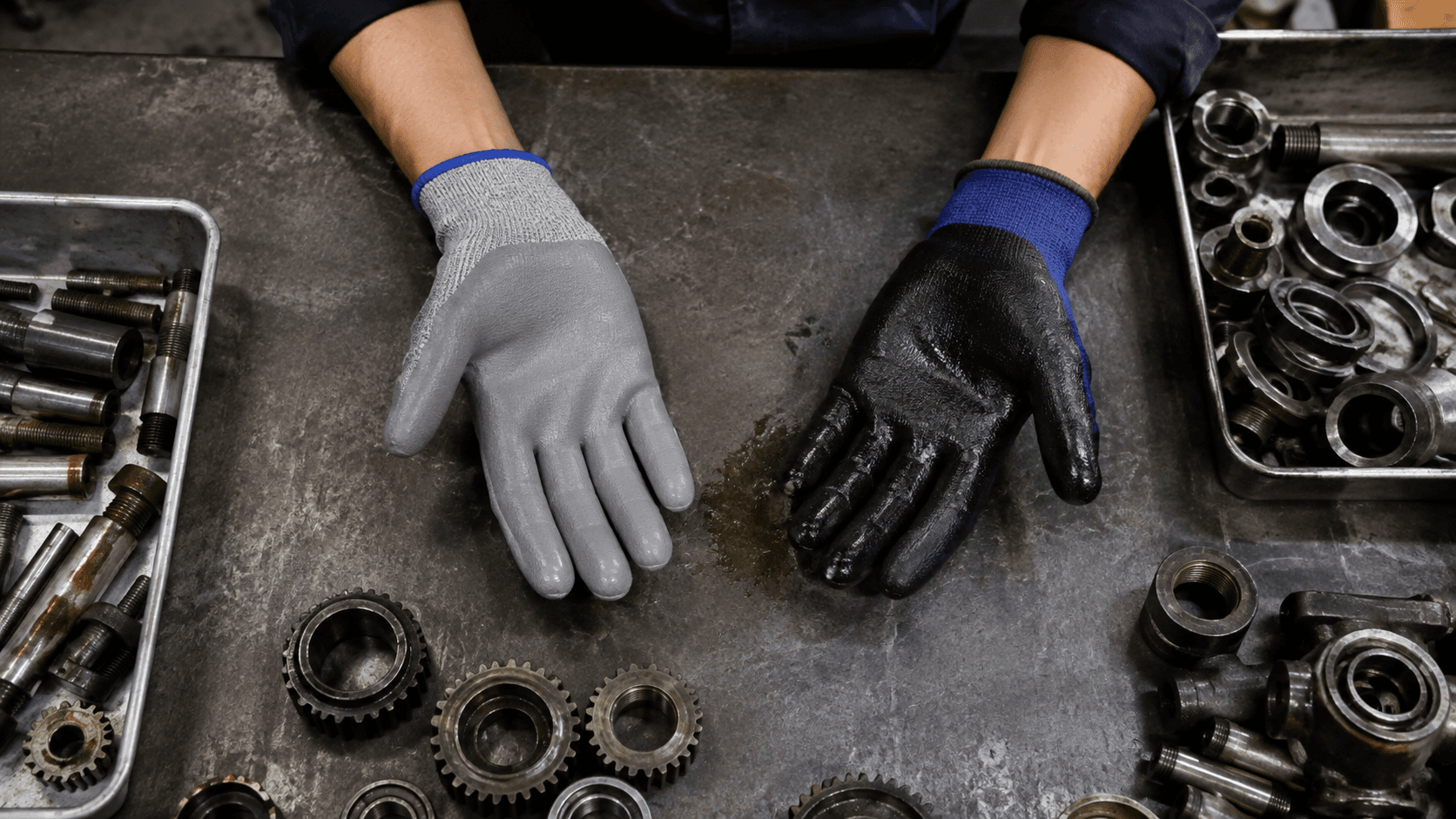
Illustrative image, not evidence of testing or a documented customer project. Procurement guidance does not replace product instructions or competent workplace assessment.
Primary topic: safety gloves protection hazards and limitations
Introduction
Safety gloves can reduce exposure to specific hand hazards when the exact product is suitable for the assessed task, correctly fitted and used within its instructions. Depending on the verified construction and claims, those hazards may include abrasion, cuts, certain puncture mechanisms, chemicals, temperatures or other defined exposures. No glove protects against every hazard.
The limitation is as important as the protection claim. Cut-resistant does not mean cut-proof. A coated palm is not automatically a complete liquid barrier. A warm glove is not evidence of electrical insulation or protection against a hot surface. Buyers should describe what the evidence supports and avoid filling the gaps with assumptions.
This guide explains common boundaries in procurement terms. It does not authorize hazardous work or replace a competent assessment. The practical examples are hypothetical and focus on decisions, not dangerous demonstrations. Never deliberately expose a hand to a hazard to test a glove.
Put gloves within the complete control system
Gloves act at the hand, after other controls have been considered. They do not remove a sharp edge, enclose a process or prevent unexpected machine movement. The work method, equipment condition, guarding, isolation and handling arrangements remain essential.
This matters commercially because an order for a more heavily reinforced glove can be used to avoid investigating the source of repeated damage. Procurement should ask whether the task has changed or whether a process improvement is needed, rather than treating every incident as a request for a higher rating.
OSHA's nonmandatory PPE selection guidance notes that no glove protects against all potential hand hazards. The buyer's practical response is to maintain a defined approved application and explicit exclusions for each selected model.
Mechanical protection has several different boundaries
Abrasion, cuts, tears and punctures are distinct mechanisms. Relevant test results help characterize a product under defined conditions, but they are not a guarantee against every workplace object or movement. Shape, force, location, contamination and the state of the glove can affect the real exposure.
Ask which part of the glove provides the declared protection. A reinforced palm does not automatically imply identical performance at the cuff, finger sides or back. Read the manufacturer's information rather than assuming uniform protection from a photograph.
Cut resistance is not permission to handle blades carelessly
A cut rating supports a particular performance claim. It does not make deliberate blade contact safe or eliminate the need for handling aids and safe methods. Do not use videos of a person pressing a blade against a worn glove as purchasing evidence.
For an assessed sharp-component task, define the actual contact and required evidence. Compare products under the relevant system, then evaluate usability using approved methods. The cut-resistant glove buying guide provides a starting point for that discussion.
Puncture and needle exposure must not be confused
A general puncture result should not be extended to every point shape. Needles and other fine sharp objects can present a different mechanism from the probe used in a mechanical test. If that exposure is relevant, identify it explicitly and request appropriate product-specific evidence.
Unknown waste, concealed sharp objects and damaged packaging should be managed through the site's procedures. A higher-looking rating does not justify reaching blindly into an uncertain area. Procurement should preserve this limitation in application descriptions and customer communication.
Chemical protection depends on the exact exposure
Chemical glove selection requires the identity of the substance or mixture, concentration, temperature, contact pattern and product model. Material families can perform differently across chemicals and constructions. The presence of nitrile, latex or another polymer in a description does not establish universal suitability.
Chemical degradation, permeation and penetration describe different issues. A glove may not visibly fail before an exposure problem occurs. Therefore, visual inspection alone cannot establish continued chemical protection, and a generic chart cannot define a safe wearing period for every task.
HSE's chemical glove selection leaflet explains that no single material provides unlimited resistance to all chemical agents. Keep the evidence tied to the actual model and conditions, and seek qualified review when the necessary data are absent.
Coverage is part of the barrier question
An uncoated back, open cuff or inappropriate interface with clothing may leave a route of exposure. A construction chosen for ventilation during dry handling may be unsuitable where the assessment requires different coverage. Do not solve that uncertainty by assuming that the palm coating protects the entire hand.
The chemical-resistant glove selection guide describes the information buyers should gather. If the chemical product changes, revisit the selection rather than assuming a similar smell, color or application means equivalent exposure.
Thermal protection is not a single temperature promise
Heat and cold can involve different contact mechanisms and work conditions. A thermal claim must be understood in the context of the applicable test, exposure type and instructions. Do not convert a laboratory result into permission to hold any object at that temperature for an arbitrary duration.
A thick lining may improve comfort in some conditions but does not establish every thermal protective property. Moisture, compression, movement and the whole glove construction can matter to the actual application. The responsible assessor should determine suitability using the manufacturer's evidence.
Where a task involves serious thermal hazards, procurement should request specialist review and a clear specification. It should not propose an ordinary handling glove because the material looks heavy or because a salesperson describes it as heat resistant without supporting detail.
Electrical and specialist claims require explicit evidence
Ordinary work gloves must not be assumed to provide electrical protection. Polymer coatings, dry fabric or thick leather are not a substitute for the relevant product classification, inspection regime and approved work method. Electrical tasks require qualified planning and selection.
Likewise, impact features, biological protection claims and other specialist applications need their own evidence. A padded back may look protective, but appearance does not establish a defined impact performance. A disposable construction does not automatically make a glove medical, sterile or suitable for every biological exposure.
The correct purchasing question is specific: “What evidence supports this claim for this model and intended use?” If the answer is unclear, do not repeat the claim in a catalog, quotation or online article as an established fact.
Ask PPEgen to clarify a glove's intended use and limitations. Send the task, exposure and model details so the product information can be organized for your responsible technical reviewer.
Fit and condition can undermine an otherwise suitable choice
A glove must remain usable during the approved task. Excess material, restricted movement, poor cuff fit or repeated twisting can lead to workarounds. A user who repeatedly removes a glove to operate a control is signaling a problem that deserves review.
Damage, contamination and inappropriate cleaning can also change whether a glove remains suitable. Follow the manufacturer's instructions and workplace procedure. Do not assume that a glove is acceptable simply because its original rating remains visible on the back.
Separate appearance from condition. A glove can look dirty without necessarily being damaged, but it can also look clean while having an unresolved chemical exposure or other problem. The decision to continue use should follow the appropriate criteria, not a quick aesthetic judgment.
Do not invent a universal service life
Replacement depends on the product, exposure, condition and instructions. A fixed claim such as safe for a certain number of shifts is misleading unless appropriate evidence and conditions support it. Buyers should instead establish the approved inspection and replacement arrangement for the application.
Keep replacement stock accessible. A well-written procedure is difficult to follow if workers must continue with unsuitable gloves because the correct size is unavailable. Supply continuity is therefore part of maintaining the approved protection system.
Machinery interactions can reverse the assumption that gloves always help
Some tasks around machinery require particular attention to entanglement or other interaction hazards. Gloves do not make it safe to reach into moving equipment. The responsible assessment and equipment instructions determine the appropriate controls and whether gloves are suitable for the specific activity.
Procurement should not resolve this question by selecting a tighter cuff or stronger tear rating on its own. Those features do not replace guarding, isolation or a safe work method. When the task description includes rotating or moving equipment, refer the question to the competent site function.
Write approved-use statements narrowly enough to avoid confusion. A glove approved for handling components at a designated isolated station should not be marketed internally as approved for every operation on the production line.
Use a limitations matrix in the purchasing record
A short matrix helps technical reviewers and commercial teams preserve the boundaries of a product claim. Keep it linked to the exact model and instruction version.
| Claim under review | Evidence question | Limitation to preserve |
|---|---|---|
| Cut resistance | Which system, method and result apply? | Not cut-proof or approval for deliberate blade contact |
| Puncture resistance | Which probe and mechanism were evaluated? | Not automatic evidence for needles or every sharp point |
| Chemical resistance | Which substance, condition and model data apply? | Not universal chemical protection or an unlimited wear time |
| Thermal protection | Which exposure and test support the claim? | Not a general permission for every hot or cold object |
| Impact protection | Which areas and evidence are covered? | Not protection against every crushing mechanism |
| General handling | Which assessed tasks are approved? | Not approval for all machinery or specialist hazards |
This table is a review aid, not a complete hazard assessment. Add task-specific restrictions supplied by the responsible reviewer and manufacturer. Do not remove limitations because they make a sales description less concise.
Test assumptions with realistic decision examples
Hypothetical example: a high cut rating and a cleaning task
A fictional buyer considers using an existing cut-resistant glove for wiping equipment with a cleaning product. The glove has useful mechanical documentation but no relevant chemical evidence. The correct conclusion is that the cleaning use remains unapproved, not that the high cut rating provides a safety margin for chemicals.
The buyer gathers the cleaning product information and asks for a chemical-specific review. The resulting arrangement may require another glove and a controlled change procedure. The example demonstrates separate evidence requirements, not a recommendation for a particular material.
Hypothetical example: reinforced gloves and awkward handling
A fictional receiving team prefers a heavily reinforced model, but several users struggle to grip an approved smooth package. Rather than accepting the problem as the price of protection, the buyer reviews fit, handling method and alternative approved candidates.
The review may retain the original glove for one task while selecting another for a different task. It may also identify a handling aid. The important point is that more reinforcement does not remove the need to evaluate normal task performance.
Communicate limitations through the supply chain
Importers and distributors should keep product descriptions aligned across quotations, websites, packaging and instructions. A careful technical file is undermined if an online listing says protects against everything. Train commercial staff to distinguish supported claims from questions that require technical review.
Record customer requirements clearly and avoid accepting vague requests such as strongest glove without clarification. Ask which hazard and work conditions the customer means. Where the buyer cannot assess the workplace directly, identify the customer's responsible decision-maker rather than pretending the site has been evaluated.
When a supplier changes the product or its documentation, review the implications for existing customer claims. Updated limitations may require revised sales information or application review. Treat this as product-information control, not merely a new brochure design.
Turn exclusions into actionable instructions
A limitation is useful only when the user knows what to do next. Instead of stating not suitable for an unidentified chemical and stopping there, identify who reviews the substance information and where the task must be held pending that decision. The instruction should create a safe escalation path, not leave workers to improvise.
Likewise, if a glove is approved only for a defined handling stage, explain the change point and where the next approved protection is obtained. Keep the wording short enough for practical use while retaining access to the detailed instructions. Clear boundaries help supervisors apply the selection consistently across shifts and temporary staffing changes.
FAQ
Are cut-resistant gloves cut-proof?
No. Cut resistance is a defined performance characteristic, not an absolute guarantee. Use the appropriate evidence and assessed work method, and never deliberately expose a hand to a blade to demonstrate a glove. Handling aids and process controls remain important.
Can a general work glove protect against chemicals?
Only where appropriate product-specific evidence and the task assessment support that use. A coating material or water-resistant appearance is insufficient. Identify the actual chemical exposure and verify the exact model instead of assuming general handling protection includes chemical protection.
Does a thick glove provide electrical protection?
Do not assume that it does. Electrical protection requires the appropriate specialized product and approved procedures, selected by qualified people. Thickness, dryness or polymer content in an ordinary work glove is not a substitute for that evidence.
Are gloves always safer around machines?
No universal statement is appropriate. The task, equipment and interaction hazards must be assessed. Gloves do not replace guarding or isolation, and procurement should not decide suitability around moving equipment from glove appearance or cuff tightness alone.
How can a buyer avoid overstating a glove's capabilities?
Use precise model-specific claims, identify the relevant evidence and retain important limitations. Keep sales copy consistent with instructions. Avoid absolute phrases and ask for technical clarification when a customer requests protection outside the documented scope.
What should happen when the hazard is unknown?
Hold the selection or affected task for investigation by the responsible workplace function. Choosing a thicker or more expensive glove does not resolve an unidentified exposure. Record the missing information and obtain a suitable assessment before approving the application.
Conclusion
Safety gloves provide defined protection, not universal immunity from hand hazards. Their value depends on the exact product, exposure, fit, condition and work method. Mechanical ratings, chemical data and specialist claims must remain within their documented scope.
Buyers should make limitations visible in specifications, training information and sales descriptions. A product with clear boundaries is easier to select responsibly than one promoted through broad promises. When the evidence does not answer the task, pause and resolve the question rather than inventing a safety margin.
Send PPEgen your glove application questions or email info@ppegen.com. Include the hazard, work conditions and required evidence so the discussion can focus on supported protection and clear limitations.
BUYER RESOURCES
Continue your PPE sourcing research.
Explore relevant PPE categories and a primary safety reference alongside this guide.Use this source alongside destination-market requirements for the exact product and application.
READY TO DISCUSS YOUR REQUIREMENT?