BUYER'S GUIDE - 4 MIN READ
PU vs Nitrile Coated Work Gloves: How to Select the Right Coating for Industrial Work
Editorial information, sources and corrections
Compare PU and nitrile coated work gloves for grip, dexterity, abrasion, oil exposure, production quality control and B2B sourcing.
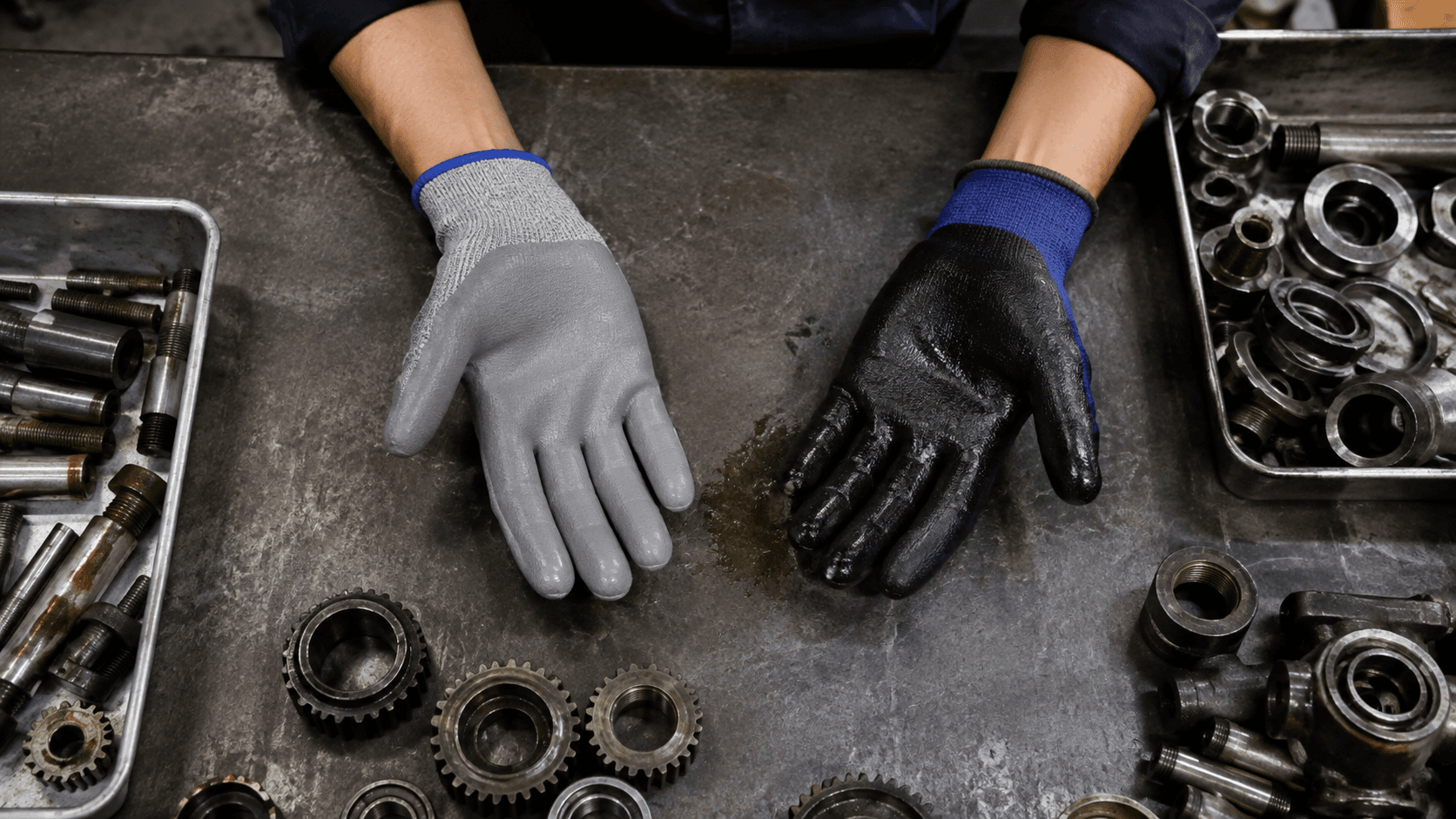
Primary topic: PU vs nitrile coated work gloves
Introduction
PU and nitrile are both common glove coatings, but they solve different handling problems. A buyer who selects only by colour, unit price or a generic “oil resistant” description can receive gloves that feel wrong, wear too quickly or fail to provide usable grip on the actual component. The reliable starting point is a task trial and a written specification.
Quick answer: Use PU-coated gloves when fine handling, feel and clean/dry grip are central to the work. Consider nitrile-coated gloves where durable grip and exposure to oils or industrial handling conditions are more important. Confirm the exact coating, coverage, liner and tested performance for the intended task.
What changes when the coating changes?

The glove liner supports fit, breathability and mechanical performance; the coating affects grip, surface feel, flexibility, abrasion behaviour and resistance to particular workplace exposures. Coating chemistry alone does not justify a chemical-protection claim. If chemicals are present, the buyer must specify the actual chemical, concentration, temperature and contact condition and obtain manufacturer-specific compatibility information.
| Feature | PU coating | Nitrile coating |
|---|---|---|
| Typical buyer priority | Fine dexterity and tactile feel | Robust grip and durability in industrial handling |
| Common task examples | Assembly, component handling, inspection | Metal handling, maintenance, oily parts, logistics |
| Must still be checked | Liner gauge, coating coverage, grip and abrasion | Surface finish, coverage, oil condition, abrasion and fit |
This is a selection guide, not a promise that one coating protects against every liquid or chemical. PPE should be chosen from a workplace hazard assessment and used with process controls.
Evaluate the actual product application
Build a small trial using the objects workers handle: fasteners, smooth metal, cartons, oily parts, tools and controls. Record the task, duration, surface condition and user feedback. A glove that performs well on a dry sample board can feel unsafe on a lubricated component. A glove with heavy coating can be durable but too stiff for small-parts work.
Questions that improve sample approval
- Is the liner nylon, polyester, HPPE blend or another stated construction?
- What is the gauge or thickness, and what size range is offered?
- Is coating palm-only, 3/4 dipped or full dipped? Is the finish smooth, foam, sandy or micro-foam?
- What mechanical-performance information applies to this exact model?
- Does the glove maintain grip after a realistic work cycle?
When cut hazards exist, coating selection is only one part of the decision. Review our cut-resistant glove buyer guide for how cut rating, liner, cuff and user fit combine.
Factory testing and quality control for coated gloves
A type-test report may support a performance claim, but it does not replace production checks. The approved sample should define liner, yarn colour, coating type, coverage, texture, cuff, size labelling and packing. During production and shipment inspection, examine:
- Coating coverage, pinholes, bare areas, uneven texture and contamination.
- Pair matching, liner defects, loose yarns, cuff finish and thumb-crotch construction.
- Stated size and actual measurement against the approved tolerance.
- Model name, carton labels, quantities, logo position and packing configuration.
- Batch information and sample records so future complaints can be traced.
In real factory testing, it is useful to retain an approved sample and a production sample from each agreed lot where commercial conditions allow. If a coating supplier, coating coverage or liner changes, treat it as a specification change and have the buyer approve it before packing. “Same hand feel” is not a complete quality-control criterion.
Compare glove quotations accurately
Ask every supplier to quote the same coating, liner, gauge, size mix, cuff style, packing and performance requirement. An apparently low-priced nitrile glove may use a different liner, thinner coating or smaller pair count; a PU glove may quote only palm coating when the project requires greater coverage. Include MOQ by size, private-label artwork, production lead time and carton dimensions.
For supplier management, refer to our PPE supplier selection guide. Before release, use the documented sampling and carton checks in our pre-shipment inspection checklist.
FAQ
Are nitrile-coated gloves chemical resistant?
Do not assume so. Chemical protection depends on the exact chemical and glove construction. Request manufacturer-specific compatibility data and let a qualified safety professional make the selection.
Which coating is better for oily parts?
Many buyers start with nitrile-coated options for oily handling, but the actual grip depends on coating finish, liner and oil condition. Trial the real task before bulk approval.
Why is the liner important?
It affects fit, comfort, cut performance, dexterity and how the coating behaves. A coating cannot be evaluated as if it were separate from the glove construction.
Conclusion
PU versus nitrile is a practical choice about grip, feel, durability and work environment. Define the task, trial the approved construction, control changes at the factory and inspect the packed order. That turns a coating name into a repeatable purchasing specification.
CTA: Ask for a Coated-Glove Sample Plan
Send your parts, work conditions, required sizes, target market and annual quantity. PPEgen can recommend the questions to include in a glove sample and quote comparison.
BUYER RESOURCES
Continue your PPE sourcing research.
Explore relevant PPE categories and a primary safety reference alongside this guide.Use this source alongside destination-market requirements for the exact product and application.
READY TO DISCUSS YOUR REQUIREMENT?