BUYER'S GUIDE - 12 MIN READ
Safety Glasses Nose-Bridge and Temple Fit: A Bulk Buyer’s Evaluation Guide
Editorial information, sources and corrections
Evaluate safety glasses nose-bridge and temple fit across users, movement and other PPE before approving a bulk eyewear order.
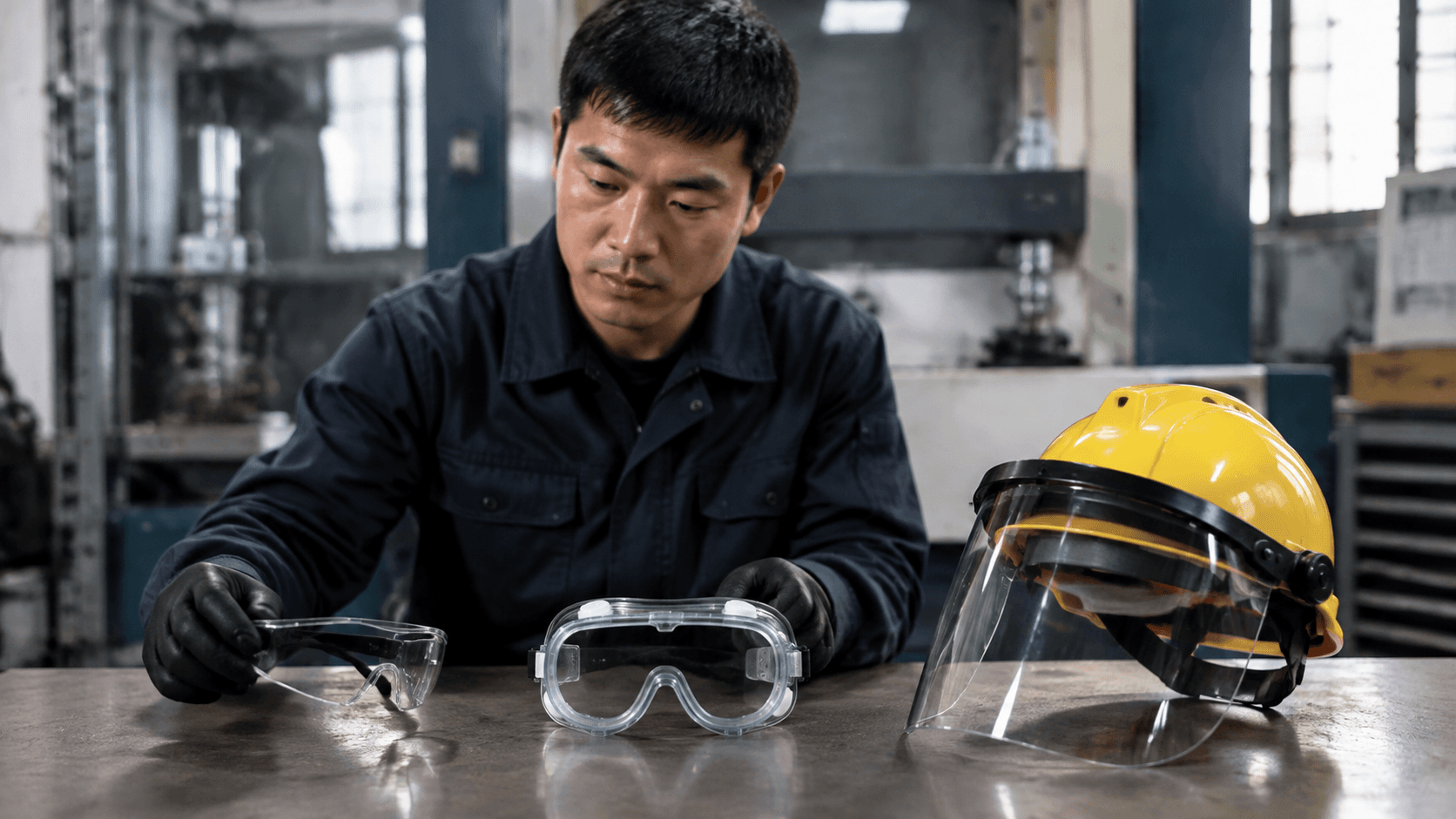
Illustrative image, not evidence of testing or a documented customer project. Procurement guidance does not replace product instructions or competent workplace assessment.
Primary topic: safety glasses nose bridge fit
Introduction
Safety glasses nose bridge fit affects stability, comfort and the way a protective frame sits on the face. Temple length, width, adjustment and pressure also influence whether a user can wear the product correctly. One appealing sample on one face cannot establish fit across an industrial workforce.
For distributors and purchasing teams, fit evaluation should connect frame geometry with the intended users, tasks and other PPE. Start with products that meet the required protection and manufacturer instructions. Then compare approved adjustments, movement stability and wearer acceptance. A well-fitted ordinary spectacle is not automatically suitable protective eyewear.
This article provides a practical sample and procurement workflow. It does not define a universal facial measurement threshold or claim that one bridge style fits an ethnic group. Representative user trials are more reliable than assumptions based on appearance or broad population labels.
Quick answer: Evaluate safety glasses on representative users with the intended PPE set and safe task movements. Check bridge support, temple pressure, lens position and stability using only approved adjustments. Record the exact model and fit limitations. If one frame does not fit everyone, maintain an approved alternative rather than modifying the product outside its instructions.
Define fit as more than comfort
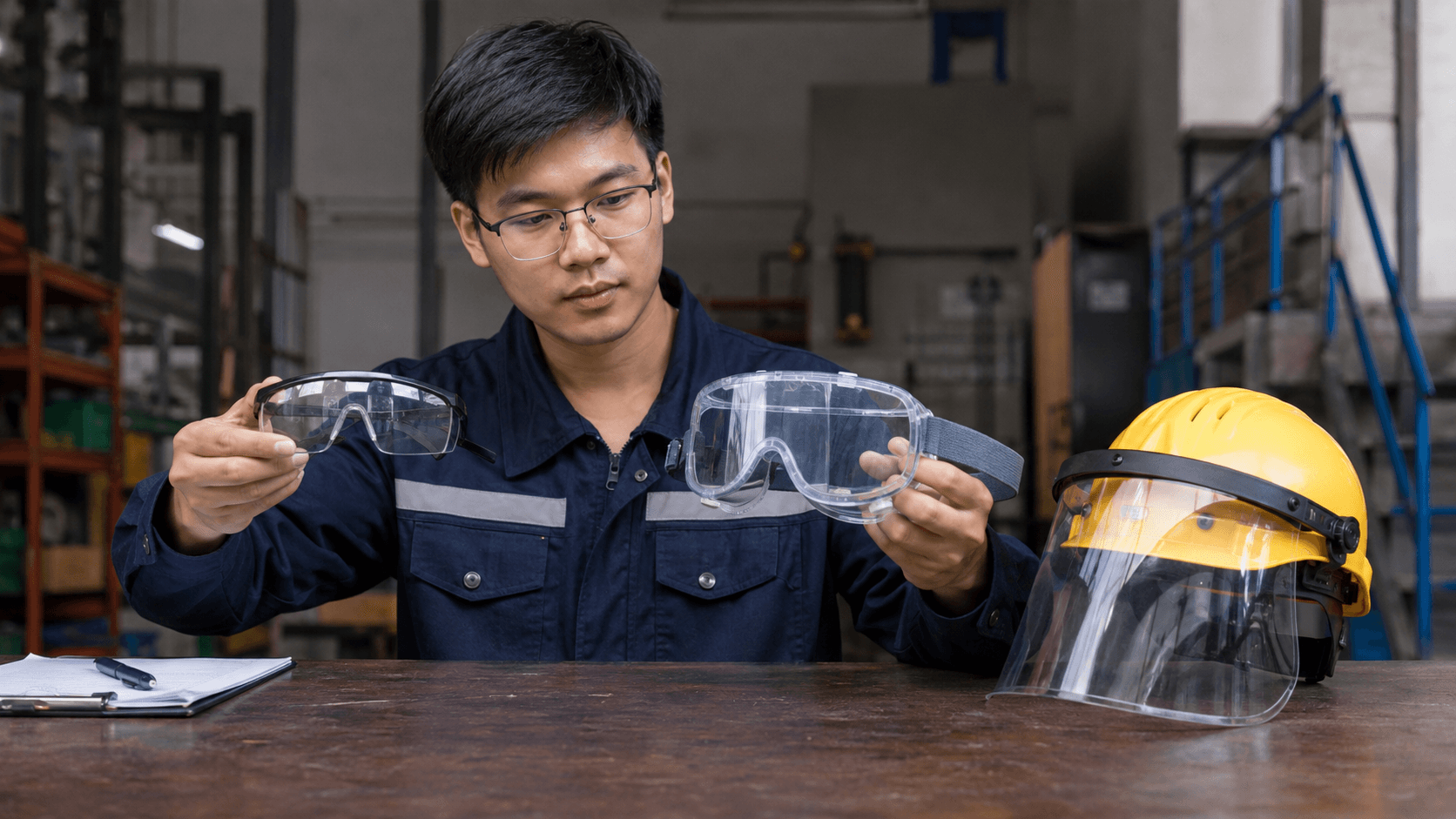
Comfort matters, but it is only one part of fit. A product can feel light while sitting in a position inconsistent with its intended protection. Conversely, a tight frame may feel secure but create pressure that encourages repeated removal. Review position, stability and correct wearing alongside user feedback.
The Occupational Safety and Health Administration’s eye-protection rule includes requirements relevant to hazards and prescription lenses. Frame fit should be assessed within that protective context. Do not let a comfortable sample eliminate a required feature such as suitable side protection.
Specify the intended user group
Describe actual workplace users and relevant differences without making unsupported demographic claims. Include people who wear prescription glasses, head protection or hearing protection where applicable. Identify tasks requiring looking down, reaching or moving between areas. A seated fitting alone may miss stability problems during routine work.
Use a confidential and proportionate process for personal fit information. Procurement needs to know which models are acceptable, not to collect unnecessary personal health details. Where a concern needs professional assessment, use the workplace’s established route rather than asking a supplier to diagnose it.
Examine nose-bridge geometry
Ask whether the bridge is fixed, adjustable or supplied in different versions. Review contact location, pad construction and permitted adjustment. A wider or narrower bridge can change where the frame sits, but catalog dimensions do not fully predict the fit on a particular face. Physical samples remain important.
Record whether the glasses slip, create localized pressure or sit away from the intended position. Check behavior during safe movement as well as at rest. Do not add tape or reshape a frame to make a sample pass unless the manufacturer explicitly permits that adjustment or accessory.
Evaluate adjustable parts within instructions
Adjustability can expand the usable range, but only if wearers can understand and operate it correctly. Ask the manufacturer how adjustments should be made and what limits apply. Have the trial user perform the adjustment after instruction, then check whether the position remains stable.
If adjustment steps are difficult with gloves or under normal issue conditions, record that operational concern. The purchasing team may need a different frame or a better fitting process. A technically adjustable product is not automatically convenient for every workforce and task.
Evaluate temple length and pressure
Temples can contact the side of the head or behind the ear in different ways. Compare pressure, stability and accessibility with the intended PPE. Soft-looking material does not guarantee comfort, and a flexible temple is not automatically suitable beneath every earmuff seal. Assess the combination rather than isolated appearance.
Ask for frame width and temple information where available. Identify whether the supplier offers different sizes or adjustment positions. Keep the exact variant in the sample record; similar frames can arrive with different temple construction. A purchasing description such as “comfortable universal fit” is insufficient for repeatability.
Review pressure over a realistic safe period
Immediate impressions may differ from later feedback. Use a trial duration appropriate to the safe activity and document it. Ask users about pressure points, slipping and frequent repositioning. Do not require a user to tolerate unacceptable fit simply to complete the scheduled evaluation.
For an illustrative trial, record observations after initial fitting and after 30 minutes of approved nonhazardous activity. That is an example observation interval, not a standard proving comfort or protection. The technical team should decide the trial scope and whether additional assessment is needed.
Check compatibility with the complete PPE set
Helmets, respirators and hearing protectors can change eyewear position or pressure. Use the actual approved models during a fitting trial. Check whether temples interfere with adjustment or whether a respirator affects the bridge position. Keep the wearer’s required equipment on rather than removing it to improve the eyewear result.
Our PPE compatibility checklist provides a framework for the complete set. The Health and Safety Executive’s hearing-protection guidance also highlights compatibility in that program. An eyewear-only trial cannot resolve every combined-equipment question.
Handle prescription users separately where needed
Ask whether the selected product incorporates a prescription, is an approved overspectacle design, or uses another manufacturer-approved approach. Ordinary eyewear underneath can change contact and stability. Compare the intended arrangement safely and avoid assuming that a standard spectacle frame will fit over every prescription shape.
Our over-prescription eyewear trial guide covers that decision in more detail. Keep its outcome linked to the accepted model and user group. A trial of one prescription frame should not become a universal compatibility claim for all prescriptions.
Build a practical trial form
Record sample identity, adjustment settings, other PPE and task movements. Include bridge support, temple pressure, stability and visual usability as separate observations. A yes/no acceptance field can be more useful than a complicated total score when one fit issue is enough to reject a model.
| Observation | Question to ask | Useful record |
|---|---|---|
| Bridge support | Does the model stay in its intended position? | Slipping or pressure location |
| Temples | Is pressure acceptable with the full PPE set? | Position and user comments |
| Movement | Does safe task movement displace the frame? | Movement and adjustment used |
| Vision | Is visibility acceptable in the approved configuration? | Specific concern or no concern |
| Instructions | Can the wearer adjust and care for it correctly? | Training or design issue |
Use representative users rather than relying only on the purchasing team. Include the fit situations important to the order. If using 2 candidates and 5 observations, explain that these are trial design choices, not statistical proof that the selected model fits every worker. Preserve written exceptions.
Send Your Requirements: Tell PPEgen the intended eyewear application, user fit concerns, required protection and other PPE. Request identified frame options and approved adjustment instructions. A comparison sample set can help your workplace decide whether one or several models are needed.
Decide whether to maintain more than one frame
A second approved frame can address users who cannot achieve acceptable fit with the main model. Evaluate that option against inventory and issue complexity. Standardizing one SKU is commercially convenient, but forcing an unsuitable fit can undermine correct use. Keep alternatives controlled and easy to identify.
Document the selection rule without labeling users inappropriately. Stores staff should know when to refer a fit concern and which approved alternatives are available. Avoid issuing an unreviewed fashion or prescription frame as a substitute. Each option still needs the required protective evidence.
Keep alternatives in the same purchasing framework
Compare model documents, cleaning instructions and replacement availability for every approved option. If lens treatments differ, record the difference and intended use. A secondary frame should not become an undocumented exception simply because fewer units are ordered. Include it in shipment and receiving checks.
The Health and Safety Executive’s PPE guidance provides the broader selection context. The purchasing decision should support correct wearing and user acceptance. It should not convert a local fit observation into a broad medical or demographic claim.
Write a repeatable frame specification
Identify the accepted model, frame size, bridge version, temple construction and adjustment features. Attach photographs and the approved sample reference. Request any dimensional information used in the decision, but define its measurement method if a tolerance is agreed. Supplier and inspector need the same landmarks.
State the required protective documentation and marking. Factory testing should support the relevant exact-model claims. A fit trial supports application review within its scope; it does not replace protective qualification. Keep those evidence types separate in the approval record.
Require notice of design changes
A changed nose pad or temple material may affect user acceptance even when the front view looks similar. Require review before substituting it. Ask whether the modification changes documentation applicability or instructions. Retain the earlier reference so that the reason for approval remains reconstructable.
Normalize price and pack units across candidates. Include any approved storage case or cleaning item in the quote where it forms part of the intended program. A cheap frame with different fit and care assumptions is not a direct equivalent to the accepted option.
Inspect bulk fit features without pretending to fit every user
Shipment inspection should verify model identity, construction, adjustment function and visible condition against the approved specification. Check representative cartons and variants. Confirm pads and temples match the accepted reference. A product can be labeled correctly while an unapproved component differs.
Inspectors can check agreed dimensions and workmanship, but cannot establish fit for every eventual wearer from one sample. Workplace fitting remains necessary. Our PPE inspection guide helps organize the commercial release decision without confusing it with individual suitability.
Record field feedback for repeat orders
Track slipping, pressure, frequent adjustment and withdrawal separately from coating or damage complaints. Note the PPE configuration and model. Repeated fit concerns may justify a new sample review or an additional approved frame. Do not average away a consistent problem in a smaller user group.
Review whether issue instructions and fitting support are accessible. A user may not know an approved adjustment exists. Correct that process before assuming the frame must change. Where a design limitation remains, record it accurately and use an acceptable alternative rather than modifying the product informally.
Example: keep an approved second frame without confusing issue
Suppose the main frame fits most users in a trial, but a smaller group cannot maintain its intended position using approved adjustment. Record the actual concerns rather than assigning them to a demographic category. Ask for another protective model that meets the same required scope and evaluate it through the relevant fitting process.
Compare the second model’s bridge, temples, instructions and evidence. It need not resemble the first frame to be useful, and resemblance does not establish equivalent fit. Keep the user observations tied to the exact candidates. If other PPE differs between groups, include that configuration in the record.
Once an alternative is accepted, define a simple issue route. Staff should know when to refer a fit concern and which approved model can be offered. Avoid a rule that lets any locally purchased frame replace the standard model. The alternative belongs in the documented assortment, not in an informal exception drawer.
Use separate stock references and clear packaging. If lens treatments or care methods differ, make those differences accessible to users. A stores team should not substitute the alternative solely because the main model is temporarily unavailable when the site’s approval depends on a particular user or configuration.
Review the size of each stock requirement through actual issue data. A trial allocation can guide the first order, but it is not necessarily a stable demand ratio. Record exchanges and unresolved fit cases. This prevents a small approved alternative from becoming unavailable while excess primary frames remain in stock.
For repeat orders, ask suppliers to notify changes in pads, temples or frame geometry. A new component can affect the reason the alternative was selected. Keep the original accepted sample and review the changed construction before treating it as the same fit solution. The objective is a practical controlled choice that supports correct wearing, not a universal claim that two frame styles cover every face.
FAQ
Can one safety-glasses frame fit an entire workforce?
It may suit many users, but that should not be assumed from one sample. Evaluate representative fit situations and provide a route for exceptions. When acceptable fit cannot be achieved through approved adjustment, consider another documented protective model rather than forcing the original frame or altering it informally.
Does an adjustable nose bridge guarantee better fit?
No. It offers an adjustment capability that must be evaluated with the frame geometry, wearer and task. Check whether the instructions are clear and the position remains stable. A fixed bridge may suit some users, while an adjustable model may still be unacceptable for others.
Should glasses be tested beneath earmuffs?
Evaluate the complete intended PPE set where both are required. Temples can interact with other equipment, and comfort alone does not resolve hearing-protection performance. Use the relevant product instructions and site assessment, and seek the appropriate program evaluation rather than approving the combination from appearance only.
Are facial dimensions enough to select a model?
They can inform sample selection, but do not fully describe support, pressure or stability in use. Trial the exact protective model with safe movements and other PPE. Record the limits of the evaluation and avoid assigning universal fit claims to a broad group based on one dimension.
What changes should trigger a new review?
Changes to bridge, pads, temples, frame size, lens treatment or approved PPE combination can justify review. So can repeated user fit complaints. Request supplier change notification and compare the revised product with the accepted reference before treating it as an equivalent repeat-order item.
Conclusion
Safety glasses nose bridge fit belongs in the same purchasing record as temples, stability and complete-set compatibility. Choose protective candidates first, conduct representative safe fitting, and retain exact model details. That makes both bulk inspection and everyday issue more consistent while allowing controlled alternatives for users who need them.
Request a fit-focused eyewear comparison
Explore PPEgen eye and face protection and request samples or a quote. Send required protection, fit concerns, other PPE and quantities. Ask for model-specific instructions and variant details so that the workplace can evaluate the relevant configurations before ordering.
BUYER RESOURCES
Continue your PPE sourcing research.
Explore relevant PPE categories and a primary safety reference alongside this guide.Use this source alongside destination-market requirements for the exact product and application.
READY TO DISCUSS YOUR REQUIREMENT?