BUYER'S GUIDE - 12 MIN READ
How Should Personal Protective Equipment Be Combined with Other PPE Without Reducing Protection?
Editorial information, sources and corrections
Use this PPE compatibility checklist to specify hard hats, eye protection, respirators, gloves, footwear and fall protection that work together for industrial teams.

Illustrative image, not evidence of testing or a documented customer project. Procurement guidance does not replace product instructions or competent workplace assessment.
Primary topic: PPE compatibility checklist
Introduction
Buying PPE category by category can create a problem at the point of use. A hard hat may be comfortable until earmuffs, safety glasses and a face shield are added. A half-mask respirator may be correctly specified on paper but lose its seal when it conflicts with eyewear, facial hair, headwear or a poorly fitted hood. A glove with excellent cut resistance can still be the wrong choice if the task requires fine assembly, reliable grip in oil or the ability to operate controls.
For a purchasing manager, distributor or project buyer, PPE compatibility means more than matching colours or consolidating suppliers. It means checking whether each item can be worn, adjusted, cleaned and replaced as part of the same protective system for the work actually being performed. This guide provides a practical checklist for building that system before a quotation is released, a sample is approved or a shipment is inspected.
Quick answer: Start with the job hazards and the user tasks, then test the intended PPE as a complete ensemble. Confirm fit, adjustment range, visibility, access to controls, respiratory seal where applicable, attachment points and product instructions. Do not assume that individually suitable items are suitable when worn together.
The employer or site safety professional remains responsible for a workplace-specific hazard assessment and for determining the PPE required in the destination market. OSHA's hazard-assessment guidance explains the importance of assessing workplace hazards and selecting protective devices that protect against the hazards identified. This article is a buyer's sourcing and specification guide, not a substitute for a site safety review, training programme or legal advice.
What PPE compatibility means in a B2B purchase
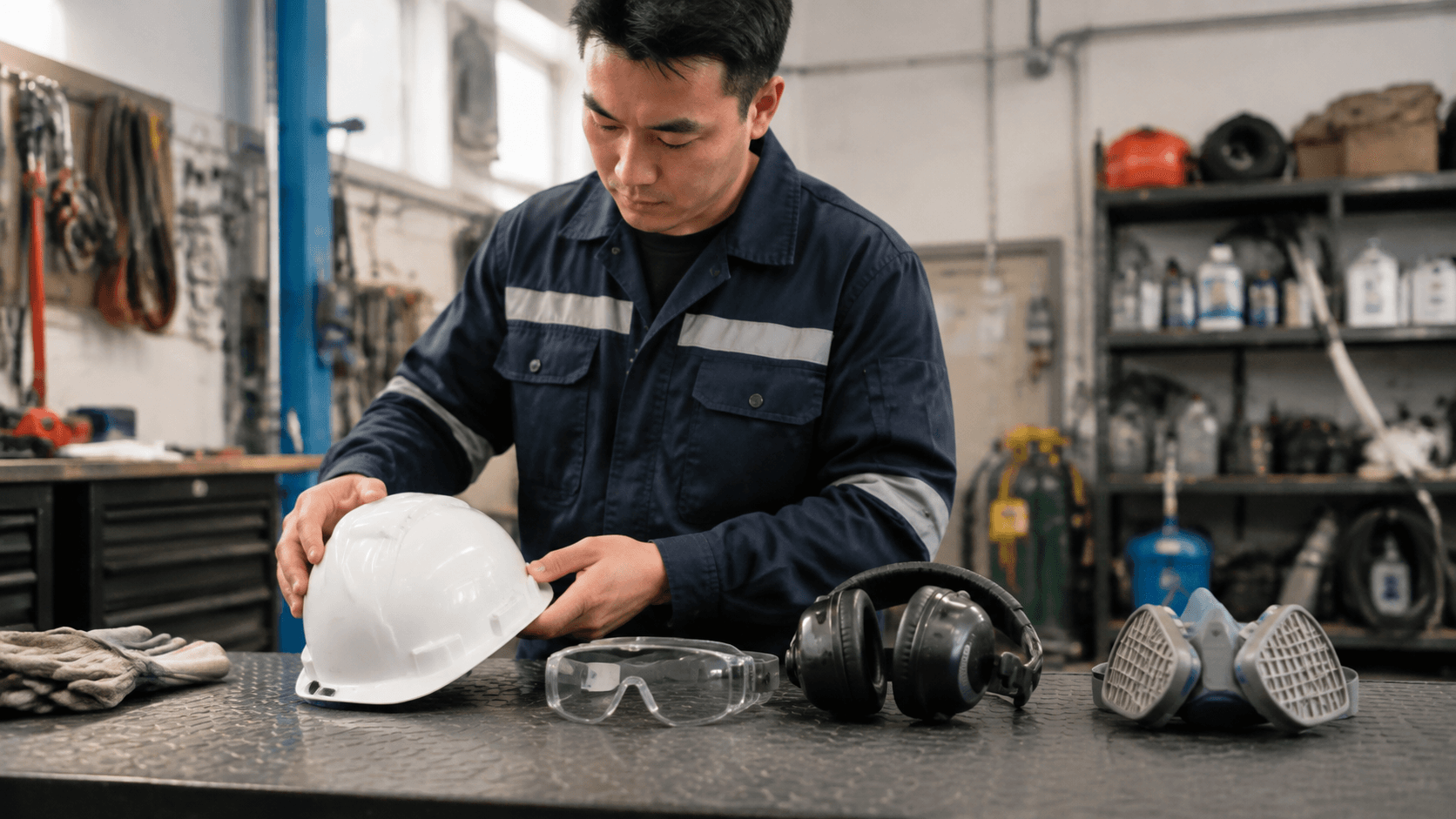
Compatibility is the ability of PPE items to work together without creating a new exposure, preventing correct adjustment or making the worker less able to do the job safely. It should be checked at three levels.
1. Physical compatibility
The equipment must not obstruct, dislodge or damage another item. Examples include:
- Safety spectacles must sit correctly under the selected eye and face protection, not lift away because of a respirator frame or helmet suspension.
- Helmet-mounted earmuffs and face shields must be designed for, or demonstrably compatible with, the chosen head protection.
- A fall-arrest harness must be accessible for adjustment and connection when a jacket, high-visibility vest or rain layer is worn over it.
- Glove and sleeve interfaces must follow the approved task-specific arrangement and manufacturer instructions, maintaining required coverage through movement. Do not assume that every glove cuff belongs inside the sleeve; review the actual exposure and complete combination.
2. Functional compatibility
The combined equipment must allow the worker to see, hear, breathe, move and communicate well enough to perform the task. A visor can change peripheral vision; thick gloves can affect dexterity; a bulky garment can restrict shoulder movement; an anti-fog treatment may be necessary when eye protection is used with a respirator. A PPE set should support the task rather than encourage users to remove an item halfway through the shift.
3. Administrative compatibility
The specification, marking, user information, cleaning instructions, replacement parts, size range and shipment records must all refer to the exact products ordered. For international buyers, this is particularly important when one project includes private labels, multiple size curves, different destination markets or several product classes. A generic certificate for a related product is not proof that the delivered SKU works within the selected ensemble.
Start with the work, not the catalogue
Before comparing products, create a short job-use profile. It turns a broad request such as "PPE for a fabrication crew" into information that a supplier can quote and a site team can validate.
Questions to collect from the customer
- What tasks are performed, and how long is each task performed during a shift?
- Which hazards may occur at the same time: impact, flying particles, dust, chemicals, noise, heat, sharp edges, fall exposure or vehicle traffic?
- Is the work indoors, outdoors, at height, in confined spaces, near moving machinery or in wet/oily conditions?
- Which PPE is already issued or mandated on site?
- Are there requirements for standards, customer-approved models, colours, logos, language or traceability?
- What size range, gender fit, prescription-eyewear accommodation and comfort concerns need to be considered?
- Is there a controlled cleaning, storage, replacement and inspection process after delivery?
This record becomes the basis for sample selection. It also prevents a quotation error: supplying a premium item in one category while ignoring the use conditions that make the entire set uncomfortable or impractical. HSE selection and use guidance highlights the need to check items worn together, including eyewear and respiratory interfaces. For buyers, that is a reason to ask the site for the whole use case before requesting a price.
The PPE compatibility checklist, by category
Use this checklist during sample review and before bulk production. Record the model, size, adjustment setting and any approved accessory. If the final ensemble differs from the sample set, repeat the review.
Head, eye and face protection
For hard hats, glasses, goggles, face shields and hearing accessories, check the following:
- The helmet is worn in the position specified by its instructions and remains appropriately fitted through required movements.
- Helmet accessories use manufacturer-approved combinations and attachment arrangements, rather than improvised clips or a merely similar slot.
- Safety glasses, goggles and face shields leave adequate space for the nose bridge, temple arms and any respirator components.
- The visor can be raised and lowered without contacting the helmet suspension or pulling on eyewear.
- The wearer can keep sufficient peripheral vision for the application, particularly near forklifts, traffic or rotating equipment.
- Replacement lenses, sweatbands and accessory parts are available under identifiable part numbers.
When planning a combined sample kit, ask the buyer to name any existing helmet brand and accessory system. A visor that looks similar in a catalogue may not be an approved combination with another helmet. Factory testing should address the relevant controlled specification; an ordinary movement check cannot establish conformity or authorize an unsupported accessory. Request the manufacturer's combination information before the site evaluates adjustment and practical fit.
Respiratory protection with eyewear, hoods and facial PPE
Respiratory PPE needs special care because model identity, approval, limitations and wearer fit all matter. For covered US workplaces, the OSHA respiratory protection rule addresses program requirements including appropriate selection, medical evaluation, fit testing and training. The site's responsible program administrator should review the actual combination; a supplier sample review does not replace those obligations.
For the procurement check, confirm:
- The requested protection type is linked to the actual contaminant and concentration decision made by the competent site team.
- Eyewear, a face shield, a hood or a welding helmet does not interfere with the selected respirator's sealing surface or straps.
- The user instructions, replacement filters or cartridges, storage method and change-out approach are clear for the exact model.
- A full facepiece is not treated as an automatic substitute for all eye and face hazards; the task assessment still controls the selection.
- Facial hair, facial shape and prescription eyewear questions are passed to the site's respiratory-programme administrator rather than solved by a purchasing assumption.
Do not describe a dust mask as compatible with every face shield or welding hood. Ask for a physical fit trial with the actual ensemble. If an export customer requests respiratory protection together with eye protection, PPEgen can organise the sample list around their stated work conditions and documentation requirements; the employer should still make the final use decision.
Gloves, sleeves and protective workwear
Hand protection must work with the workpiece, not only with a test result. Start by reviewing the task: handling sheet metal, packing cartons, oily components, glass, small fasteners, hot parts or chemicals will create different requirements. Our guide to choosing cut-resistant safety gloves explains why cut level alone does not define the right glove.
Check:
- Glove size and cuff length are compatible with the sleeve, wrist exposure and work motion.
- The glove coating and liner provide the needed grip and dexterity in the actual dry, wet or oily condition.
- The garment does not catch on machinery, snag on a ladder or prevent a secure harness fit.
- High-visibility panels or reflective material remain visible when the worker wears a harness, backpack, tool belt or outer layer.
- If chemical protection is required, the specific chemical, contact time, temperature and glove instructions are reviewed by a competent person rather than assumed from glove material alone.
At the sample stage, ask workers to pick up a representative fastener, operate a clip, hold a tool handle and perform the key movement of the job. This is more useful than asking only whether the glove feels comfortable in a meeting room. In shipment inspection, compare the delivered glove's size marking, coating coverage, colour and label with the retained approved sample.
Footwear, garments and fall protection
Footwear often affects the rest of the PPE system through mobility and fatigue. A heavier boot may offer features the project needs, yet the buyer must consider the walking surface, slip exposure, heat, kneeling, ladder work, toe room, sizing conversion and sock thickness. For a structured comparison, see our steel toe vs. composite toe safety footwear guide.
For workers exposed to fall hazards, the harness, connecting equipment, anchor approach and rescue planning must be addressed by the employer's competent person. Procurement should support that process by making sure the configuration is explicit. The fall-arrest harness inspection checklist is useful for identifying visible condition and traceability checks; it does not replace a site-specific fall-protection plan.
Before ordering, verify:
- Boot upper height and trouser leg design do not create rubbing, water entry or restricted ankle movement.
- The harness D-ring, buckles and adjustment points remain accessible over the intended garment layers.
- Tool belts, high-visibility clothing and weather layers do not hide harness labels or obstruct connection points.
- The user can reach the connection point and carry out required pre-use checks with gloves on.
- Product labels and instructions are supplied in the agreed language and are retained with the project file.
A practical buyer workflow from RFQ to shipment
The following workflow works for a distributor range, construction tender, plant shutdown or contract-manufacturing order.
Step 1: Issue one controlled requirement sheet
List each category, intended task, target market, standard or customer requirement, size range, colour, logo, packing and expected quantity. Include products the customer already owns. A clear sheet lets suppliers identify open questions early instead of making quiet substitutions after sample approval.
Step 2: Build a representative sample ensemble
Order the actual combination: helmet plus accessories, eyewear plus respirator, gloves plus sleeves, workwear plus harness, footwear plus the usual sock or trouser arrangement. Record product model codes and sizes. If several workers have materially different body shapes or task profiles, use more than one fit representative.
Step 3: Run a supervised use check
The site should test the ensemble under safe, controlled conditions that reflect the product application. Observe adjustment, fit, field of view, communication, tool handling, heat build-up, interference and any tendency to remove or alter PPE. Record findings and decisions. A supplier can support with specification information and samples; the safety decision belongs to the employer or their qualified adviser.
Step 4: Freeze the approved configuration
Once the buyer accepts the ensemble, control the model, material, colour, label, accessory, packaging and artwork. Any substitution should trigger written approval and, where relevant, a renewed compatibility check. This is particularly important for private-label projects where a change in a buckle, lens or attachment part can alter user experience.
Step 5: Inspect the shipment against the approved sample
During shipment inspection, look beyond carton count. Match representative goods, sizes, accessories, labels and manuals to the approved configuration. Photograph the result and record any discrepancy before release. Our pre-shipment inspection checklist can be used as a base for the physical and documentation review.
Planning a multi-category PPE order? Send the job type, destination market, product list, estimated quantities and any existing site equipment. Send Your Requirements to organize a clear sample and quotation checklist.
Common compatibility failures and how to prevent them
Treating PPE as a collection of independent SKUs
The cure is simple: review the actual ensemble. Bundling items in an RFQ is not the same as checking them together on a user.
Selecting by certification language alone
Conformity evidence and markings are important, but they do not answer every fit, task and interface question. Verify the product identity and instructions, then conduct the appropriate workplace assessment and fit process.
Ignoring worker variation
One size range may not suit every face shape, prescription-eyewear need, glove size or footwear fit. Ask the customer for a size curve and make sample feedback part of the approval process.
Losing control after sample approval
An approved sample has limited value if the production lot uses another lens, suspension, glove coating, label or buckle. Retain the sample, freeze the specification and compare it during shipment inspection.
Promising protection beyond the evidence
Avoid sales claims that cannot be tied to the exact model, approved use limitation and buyer's job conditions. Clear, modest product descriptions build more trust than broad claims that a site cannot verify.
FAQ
Can any safety glasses be worn with a half-mask respirator?
No. Glasses may interfere with the respirator seal or straps, and the fit depends on the exact products and wearer. The site should evaluate the combination under its respiratory protection programme and follow the respirator manufacturer's instructions.
Can a face shield replace safety glasses?
Not automatically. The right selection depends on the hazard assessment, the task and the product instructions. A face shield and safety eyewear are often specified together for certain tasks, but the site must determine the required protection.
How do buyers prove PPE is compatible before placing a bulk order?
Use a controlled requirement sheet, order representative samples, test the full ensemble in the intended use conditions, document the approved models and inspect the shipment against that approved sample. Keep all decisions with the project file.
Are products from the same supplier always compatible?
No. Compatibility depends on the specific models, accessories, fit and use conditions, not simply the supplier name. Ask for model-level information and test the intended combination.
What should be included in a PPE compatibility record?
Include job-use profile, hazard assessment reference supplied by the employer, product models and sizes, accessory configuration, sample feedback, user instructions, approved artwork/labels, change approvals and shipment inspection results.
Conclusion
A safer PPE purchase starts with a compatible system, not a long product list. When buyers collect real job information, test the complete ensemble, freeze the approved configuration and inspect the delivered goods against it, they reduce avoidable fit issues, rework and customer complaints. The approach also gives the purchasing team a cleaner record for repeat orders and project handover.
Tell PPEgen the work application, destination market, required categories and expected quantity. Request a PPE quotation or email info@ppegen.com to discuss a sample plan and the model-specific information needed for your site's compatibility review.
BUYER RESOURCES
Continue your PPE sourcing research.
Explore relevant PPE categories and a primary safety reference alongside this guide.Use this source alongside destination-market requirements for the exact product and application.
READY TO DISCUSS YOUR REQUIREMENT?