BUYER'S GUIDE - 11 MIN READ
Safety Footwear Outsole Compounds: Matching the Boot to Floor Conditions
Editorial information, sources and corrections
Compare safety footwear outsole compounds and tread against actual floors, contaminants and care conditions before approving a bulk purchase.
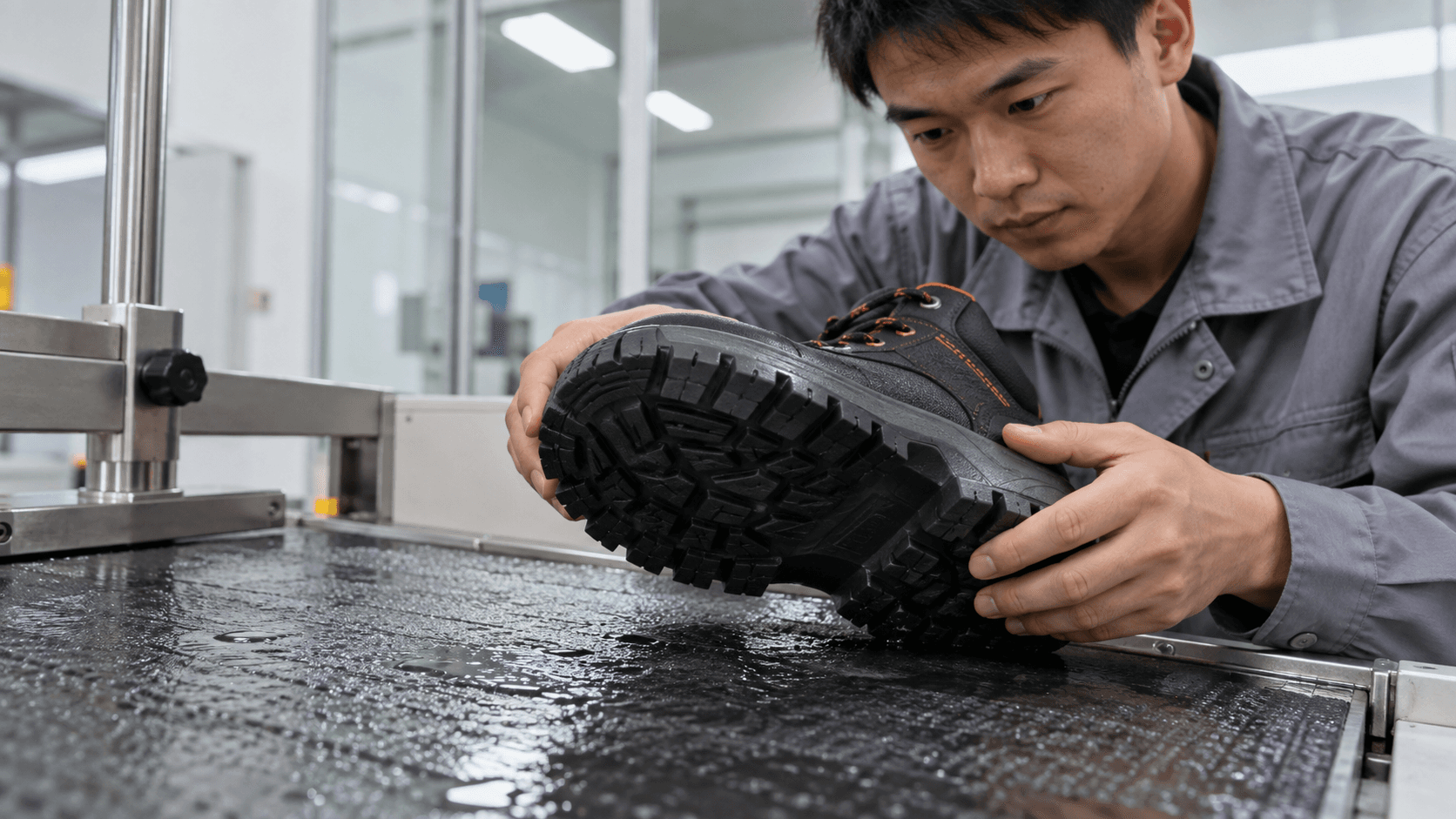
Illustrative image, not evidence of testing or a documented customer project. Procurement guidance does not replace product instructions or competent workplace assessment.
Primary topic: safety footwear outsole compounds
Introduction
Safety footwear outsole compounds should be evaluated with tread, construction and actual floor conditions. A material label such as rubber or polyurethane does not establish suitable traction for every workplace. Contaminant type, surface, wear and cleaning also affect the practical decision. Buyers should identify technically acceptable models and evaluate the intended application through a controlled process.
For importers and industrial procurement teams, this is a specification question before a price question. A quoted sole material may omit the formulation, tread or exact model evidence that matters to the site. A general nonslip claim is too broad to replace documented testing and application review.
This guide explains what to ask, how to structure safe trials and what shipment inspection can verify. It does not instruct workers to test a boot by walking deliberately into a slip hazard. The site should manage floors, contamination and footwear together rather than relying on the sole as the only control.
Quick answer: Match outsole choices to the documented floor, contamination, task and required protective capability. Compare exact models with relevant evidence and a safe trial, considering tread and fit as well as material. Define care, condition and replacement controls. A sole compound name or catalog nonslip label is not a universal traction guarantee.
Describe the floor before requesting a sole
Record surface material, condition, transitions and the contaminants present during normal work. A clean dry floor, a wet smooth surface and a location with oily residue are different contexts. Identify who controls housekeeping and which measures are already used. Footwear selection should support that system rather than conceal unresolved floor hazards.
The Health and Safety Executive’s slip-resistant footwear guidance explains that tread and compound both matter. Use its procurement context to ask better model-specific questions. Do not turn one material name into a conclusion about all floors or contaminants.
Identify work movements and other hazards
Describe walking, standing, turning and access to stairs or ladders where relevant to the approved assessment. Include other required protective features. The Occupational Safety and Health Administration’s foot-protection rule provides a workplace hazard context, but the offered model still needs evidence for the selected application.
Ask whether multiple areas require different approved footwear. One economical model may be suitable across the assessed work, or it may not. Avoid standardizing a product before the technical team has defined the relevant floor and protection conditions.
Treat compound names as incomplete specifications
Rubber, polyurethane and other labels describe broad material families. Formulation, hardness, layer construction and tread can differ. Ask the supplier for the exact model and construction description, with relevant evidence. Do not assume that two rubber outsoles are equivalent because they share a material word.
If the product has a dual-density or multilayer sole, clarify which material forms the ground-contact layer. A catalog description of the entire sole may not identify the relevant contact surface. Record the accepted construction and any model variants so that later comparisons remain meaningful.
Evaluate claims separately
Slip performance, abrasion, chemical interaction, heat resistance and electrical attributes are different claims. Evidence for one does not prove the others. Request the applicable model documents and limits for the required characteristics. Avoid adding an unsupported feature to the product listing because the material is commonly associated with it.
Our steel-toe and composite-toe comparison illustrates another independent footwear decision. Protective features should be combined in the exact model specification, not inferred from one visible component or one material family.
Examine tread geometry and condition
Review the tread pattern, depth where specified and the way contaminants may affect it. Ask for images and samples rather than relying on a sole sketch. The actual manufacturing detail can differ from a catalog drawing. Define any important geometry or measurement through a shared method.
Check how routine work may load or contaminate the sole. Material carried into the tread can change its practical condition. A workplace should have a permitted care and inspection process. Do not assume the performance of a new clean sample remains unchanged throughout use.
Keep wear observations task-specific
Retired footwear can reveal where soles wear or become damaged. Record model, size, task and retirement reason where available. Distinguish tread wear from upper damage, fit problems and contamination. A higher initial tread depth does not automatically establish a longer safe service period.
For an illustrative record, photograph heel, forefoot and side views of an identified retired pair. Those 3 views support condition review; they are not a recognized performance test. Ask the technical team what observations matter for the actual model and application.
Verify test evidence without overextending it
Request the standard, method, conditions, exact model and report reference for the relevant claim. Identify the tested surface and contaminant where the method uses them. Results support the scope of that evaluation, not every possible workplace. Ask for clarification if a supplier advertises a claim broader than its report.
Check whether a changed tread or compound remains within the documentation basis. A visually similar sole can be a different construction. Require the manufacturer’s documented answer before treating it as an equivalent. Keep the report, product marking and accepted sample connected through a stable model reference.
Do not invent comparisons between test systems
Different standards and procedures may produce results that should not be ranked directly. Request a qualified explanation rather than creating a convenient conversion table. Product-label terminology should match the exact evidence and destination requirements. A procurement comparison can describe differences without claiming unsupported equivalence.
Our slip-resistance sourcing checklist provides a broader evidence review. Keep the floor-specific decision documented separately so that a correct model report is not mistaken for proof of suitability on every local surface.
Conduct a safe application trial
The responsible site team should approve candidates and trial conditions. Fit users correctly and use safe activities. Do not stage a deliberate slipping demonstration or ask workers to enter untreated hazards. The trial can collect comfort, movement, care and condition observations while the technical assessment addresses the relevant risk.
Record model, size, socks, approved accessories and work context. Use comparable conditions where practical and explain differences. If one candidate is issued in an unrelated area, its observations cannot be attributed solely to the compound. A concise consistent record is better than a misleading universal performance score.
Include fit in the evaluation
Heel movement, forefoot pressure and incorrect sizing can affect how a wearer moves. Review them separately from sole claims. Our wide-fit footwear guide explains fit alternatives. Select among technically acceptable models using both suitability and wearer acceptance.
An illustrative trial could review 2 approved candidates in 2 defined work areas with 5 observation fields. Those quantities are planning examples. They do not establish statistical proof or certification. The site determines the actual scope and any additional technical testing needed.
Send Your Requirements: Share floor details, contaminants, required protection and fit needs through PPEgen’s inquiry page. Ask for identified outsole constructions and the evidence available for each. Include quantity and size demand so that commercial comparison follows the technically acceptable shortlist.
Write an outsole-specific RFQ
State exact model requirements, ground-contact construction, tread reference, evidence and care information. Attach an approved sample or drawing where appropriate. Request supplier exceptions and change notification. Avoid a purchasing description that specifies only oil-resistant rubber sole if it does not identify the intended claim and basis.
| Specification element | Evidence or record | Decision supported |
|---|---|---|
| Floor context | Site assessment and conditions | Application suitability |
| Sole construction | Exact model description | Product identity |
| Tread | Sample and agreed measurements | Repeatability |
| Performance claim | Relevant method and model report | Defined protection evidence |
| Care | Manufacturer instructions | Ongoing condition control |
Normalize quotation units, packing, sizes and delivery basis. A candidate with different required features is not a direct price equivalent. Ask which specification differences explain the offer. Include replacement availability and size exchanges if they form part of the customer program.
Inspect bulk soles and documentation
Shipment inspection should compare tread, construction identity, pair matching, marking and visible condition with the accepted specification. Review representative sizes and cartons under the agreed plan. Check for unapproved outsole changes, damage or packing that creates mismatch. Inspectors should know which measurements and tolerances were agreed beforehand.
Factory testing supports relevant claims through identified methods. Visual shipment checks do not reproduce every performance test. Keep release evidence clear about its scope. Our PPE inspection guide helps organize the sample, document and shipment relationship.
Investigate a sole change before release
If a supplier changes compound, tread or manufacturing construction, request a documented review. A verbal assurance that the new sole is better is not a complete approval basis. Compare the revised sample, supporting documents and intended application. Record the accepted revision if the technical team approves it.
When defects appear, identify model, size, lot and location. Separate adhesion, molding, tread, marking and packaging concerns. A useful corrective-action record names the discrepancy and verification result. Do not combine all observations into one unexplained quality statement.
Manage care and replacement after issue
Follow the exact product instructions for cleaning and condition assessment. Keep floor controls active. A footwear program cannot resolve recurring spills solely by buying a more expensive sole. Review housekeeping and the footwear together through the responsible workplace team.
Track retirement reasons and task changes. A boot used in a different area may need a new suitability review. Do not extend a sample trial to unassessed conditions through a broad all-purpose product description. Keep issue instructions and alternative models accessible to staff.
Compare cost with transparent denominators
For an illustrative order costing USD 2,400 with 120 accepted pairs, the purchase cost is USD 20 per accepted pair. A cost-per-month estimate would require actual use and replacement records. The example is arithmetic, not a PPEgen price or a service-life prediction for any compound.
Review whether recurring replacement stems from sole condition, upper damage, fit or lost stock. Those patterns support different purchasing responses. A material change should address the identified issue rather than promise a universal improvement based on a different polymer name.
Example: assess an outsole alternative after a floor change
Suppose a workplace changes part of its floor surface and asks whether the existing boot remains suitable. Start by recording the new surface and normal contaminants through the site assessment. Do not assume the old footwear approval covers the changed area because the work role has the same name.
Request exact-model evidence and current information from the footwear supplier. Identify what the evidence does and does not address. If another compound or tread is proposed, compare complete constructions rather than material names. A similar upper can conceal a different ground-contact layer and documentation basis.
The technical team should define any additional safe application review. Procurement can organize identified samples and records. Do not create a deliberate slip demonstration to rank candidates. User fit and practical care observations can support the purchasing decision while technical performance questions follow their appropriate methods.
Review other floor controls at the same time. A recurring contaminant problem may need housekeeping or process changes regardless of the footwear selected. The purchasing record should not imply that a sole choice has resolved every source of risk. Keep the accepted application and conditions explicit.
If an alternative is approved, define which work areas use it and how stock will be issued. Avoid mixing the new model with the previous boot under one generic safety-shoe SKU. Different tasks or areas may require a controlled assortment and clear instructions.
Track the relevant feedback after introduction, including fit, cleaning and retirement reasons. Keep the floor and model identities in the record. This allows a later buyer to understand why the alternative was chosen and whether a repeat order still meets the same conditions. The result should be a documented local selection, not a broad marketing statement that one compound is superior on every industrial floor.
FAQ
Is rubber always more slip-resistant than polyurethane?
No universal material ranking applies to every model and floor. Tread, formulation, contaminant and test conditions matter. Compare exact products using relevant evidence and the site assessment. Do not advertise a compound family as suitable for every surface or use one material word as a complete specification.
Does a nonslip label prove suitability for an oily floor?
Request the exact claim, relevant test conditions and model evidence. The workplace should assess its actual floor and contamination. Broad labels can conceal limited scope. Keep cleaning and other slip controls in place, and do not deliberately expose users to a hazard to demonstrate footwear performance.
Can a new tread use the old report automatically?
Do not assume so. Ask the manufacturer whether the changed construction remains within the report’s applicability and request the documented basis. Update the sample and specification after approval. A similar appearance or the same product family name is not enough to establish evidence equivalence.
What should a buyer trial record?
Record exact model, size, intended configuration, safe task conditions, fit, care and condition observations. Keep the technical risk assessment separate. A purchasing trial should explain its limits and should not be presented as a recognized laboratory slip test or a guarantee for every workplace surface.
How should replacement timing be set?
Use manufacturer instructions and the workplace condition process rather than a universal period based on material. Track retirement reasons and changes in work. Cost targets should not encourage continued use of unsuitable footwear. The responsible site team should determine when the accepted product no longer meets its use criteria.
Conclusion
Safety footwear outsole compounds are meaningful when connected to tread, exact model evidence and floor conditions. Define the task, evaluate acceptable candidates safely and preserve the construction through shipment inspection. Care and replacement records then provide a reliable basis for repeat orders and realistic cost review.
Request an outsole comparison
Browse PPEgen safety footwear and ask for a quotation. Include floor and contaminant details, required protection, quantities and sizes. Request identified sole options and supporting documents so that your technical team can review the relevant models before bulk approval.
BUYER RESOURCES
Continue your PPE sourcing research.
Explore relevant PPE categories and a primary safety reference alongside this guide.Use this source alongside destination-market requirements for the exact product and application.
READY TO DISCUSS YOUR REQUIREMENT?